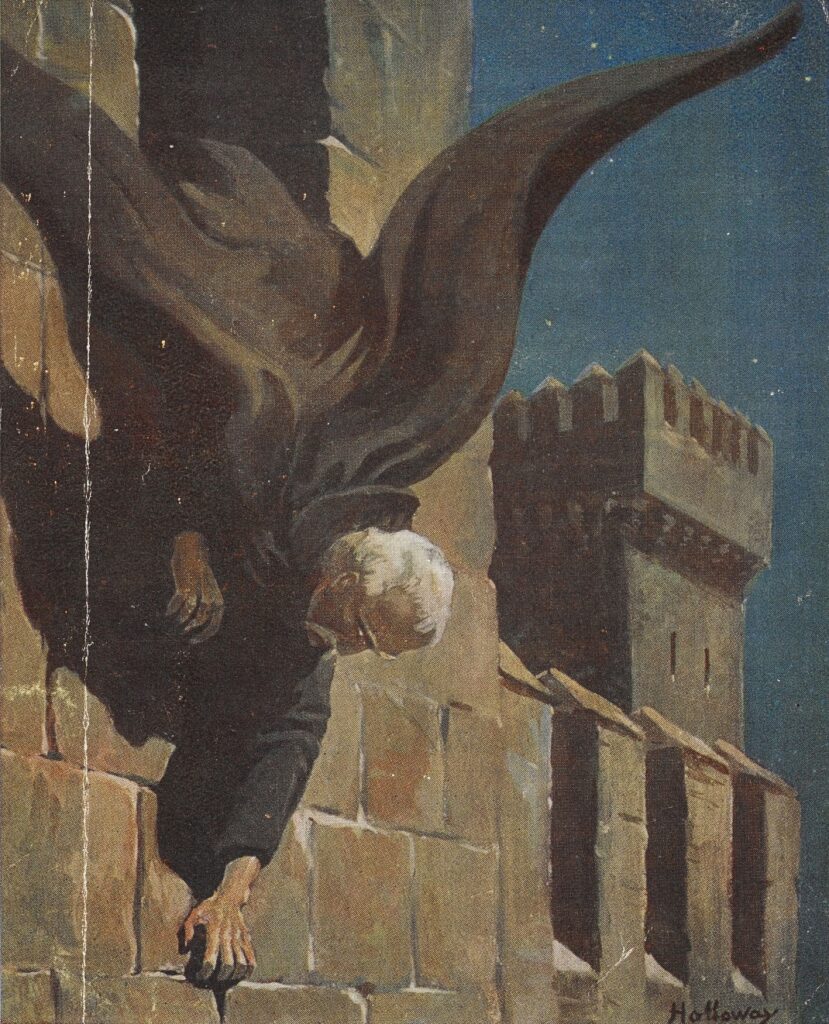
Dracula by Edgar Alfred Holloway

Available from Ignatius Press and Amazon
Book Length: 558 pages
Horror must have monsters, but the monsters of modern horror often reveal themselves to be the descendants of Lovecraft’s Cthulhu, not Stoker’s Dracula. For general sense of the horror genre in our age is that of man being relentlessly pursued and destroyed by forces inimical to him, and which are beyond his capacity to understand. This circumstance is no mere accident. Modern horror, as with other genres in art, is a reflection of the present nihilistic and atheistical state into which Western culture has degenerated.
Stoker had an entirely different concept of horror to that of Lovecraft’s nihilistic vision of cosmic indifference. It is one profoundly rooted in Christianity, grounding man in the Christian conflict between the transcendent and the demonic. And it is this vision which gave to the world the brilliantly eerie, yet redemptive story of Dracula.
This story opens with the first in a series of journal entries from Johnathan Harker, a young Englishman who is sent to meet Count Dracula in the remote Transylvanian countryside in order to finalize an important transaction. As he ventures closer to Castle Dracula, the locals regard the unwitting Harker with suspicion and frightened concern whenever they learn of his destination, for they well know the terrible truth of the Count’s identity.
Despite pleas on the part of an innkeeper’s wife to reverse his course, Harker insists adamantly that he will not allow anything to change his decision; he remains unmoved even when she begs on her knees and asks ominously: “Do you know where you are going, and what you are going to?” (20).1 In fact, such desperation rings as “very ridiculous” in his ears (Ibid).2 However, he, an “English Churchman”, accepts a rosary from her, which she lays around his neck, for “it seemed so ungracious to refuse an old lady meaning so well and in such a state of mind” (21).3
Within a few days Harker reaches Castle Dracula, and meets the Count, who greets him in a rather unnerving manner:4
“Welcome to my house! Enter freely and of your own will!”
(34)
He made no motion of stepping to meet me, but stood like a statue, as though his gesture of welcome had fixed him into stone.
This being, this “Un-Dead” (as he is later called), is thus subtly revealed to be one who lacks, not one who has. For Dracula cannot cross the threshold into the outer world; he stands “like a statue”, and in a manner evocative of the victims of Medusa, he is “fixed into stone” after inviting his guest into his domain. He cannot force Harker to enter. The Devil cannot force a man’s hand into a pact—he must entice him to enter a compact. It is the same with Dracula. A dramatic pause looms over in this moment: will Harker grasp that perhaps the country folk are right and turn back, or will he enter the castle and become Dracula’s guest?
Fatefully, Harker steps forward, and so the tragic struggle begins. As a man ensnared in sin feels the full weight of his deeds after committing them, it is only beyond the door that Harker notices the “very marked physiognomy” of the Count, with his “cruel-looking” mouth and “peculiarly sharp white teeth” (37).5 Yet Harker, though a prisoner of Dracula, is not entirely without aid against the vampire’s dark designs.
When Harker arises to shave himself some days later, he hears Dracula greet him and place his hand upon his shoulder—yet realizes that, to his shock, he cannot see the Count in the mirror. Being spooked, he jerks his razor and accidentally cuts his neck; blood trickles down his neck, and as he turns around to find something to bandage his wound, he is suddenly met with Dracula’s frenzied reaction:6
When the Count saw my face, his eyes blazed with a sort of demonaic fury, and he suddenly made a grab at my throat. I drew away, and his hand touched the string of beads which held the crucifix. It made an instant change in him, for the fury passed so quickly that I could hardly believe that it was ever there.
(49)
See here the power of God against the hand of the Devil’s slave! The “instant change” which overcame Dracula’s “demonaic fury”, his vampiric bloodlust which would have found an easy victim in Harker, was that of having come into contact with a sacramental. It is this contact which restrains him. Why? Evil cannot overcome the Good, precisely because Evil is not equal to Good; in fact, it is inferior to it. As God is, the Devil is deficient.7 Consequently the objects dedicated to God are channels of His almighty power, and work as means through which God can restrain the power of the Devil and his servants.
Dracula’s defeat enables Harker the chance to reflect on the power of the crucifix, and one senses him struck with awe, and reaching for an explanation:8
It is odd that a thing which I have been taught to regard with disfavour and as idolatrous should in a time of loneliness and trouble be of help. Is it that there is something in the essence of the thing itself, or that it is a medium, a tangible help, in conveying memories of sympathy and comfort? Some time, if it may be, I must examine the matter further and try to make up my mind about it.
(52)
Harker, an Anglican, finds consolation in the very spiritual weapon deemed powerless by Canterbury yet which has unmistakably proven itself powerful against Hell. He wavers in his assessment: is the crucifix merely a potent talisman—a merely material object with intrinsic power—having something in its “essence” which repels Dracula, or is it a “medium” which acts as a means through which something or someone else repels him? That he states his intention to “examine the matter further” at some point in the future indicates good will on his part. It also represents a trajectory which the other main characters in this work follow: a willingness to trust in the power of sacramentals, and thus in the doctrines of Catholicism, to defeat the powers of darkness manifest in the Un-Dead.
In closing, this genuine classic of horror is well worth reading. The edition which is particularly recommended to the reader is the one published by Ignatius Critical Editions, as it includes a critical introduction and appended essays which genuinely engage the text rather than ideologically bludgeon it.
Perhaps the most culturally illuminating of these essays is “The Cinematic Dracula: From Nosferatu to Bram Stoker’s Dracula” by Jack Trotter, as it examines the various cinematic representations of the Dracula story in comparison to the original tale. Of these representations, Trotter states that Nosferatu “remains the closest in spirit to the novel”, though its signature vampire Orlock “strikes the viewer as a hideous nightmare figure” rather than “a supernatural reality” (532).9
Thus the trend of these films was unfortunately naturalistic from the beginning, as they all “feature thematic variations that speak volumes about the recent secular drift of Western culture” (529).10 Viewed chronologically, Trotter posits a trend that reveals “a gradual stripping away of [Dracula’s] metaphysical attributes and a progressive tendency to humanize him, until, at the end of this evolution, he is transformed into a postmodern tragic antihero in revolt against the injustice of the Christian God” (Ibid).11
It is a lofty charge, and Trotter does well to prove it. Perhaps the Dracula films were the genesis of the now very tired and evidently sinister trope of the “sympathetic” and “misunderstood” monster in the media of our century, but the critic does not enter into that discussion. Nonetheless, the recognizably preeminent place of Dracula in vampire fiction and the general degeneration of that sub-genre to smut, gross spectacle, and even romance is proof alone that the bastardization of this work has wrought great harm to our culture. Inversely, a re-engagement with Dracula will reap admirable fruit to those of us who wrestle for the soul of the West.
While other works within this genre have caught the transitory attention of the crowd through their reliance on spectacle, Stoker’s Dracula endures. This endurance is no mere artifact of preference, but is the very real manifestation of the centralizing substance of the text: a pitched battle between the transcendent power of God against the corrupting influence of Satan.
Bram, Stoker. Dracula. Edited by Eleanor Bourg Nicholson. Ignatius Critical Editions. 2012. p. 20.
Ibid.-
Ibid. p. 21.
Ibid. p. 34.
Ibid. p. 37.-
Ibid. p. 49.
See for reference what St. Bonaventure says about sin in general:
“As sin is a defect, it has a cause which is not EF-ficient, but DE-ficient, being the defection of the created will.”
St. Bonaventure. The Works of Bonaventure: Cardinal, Seraphic Doctor and Saint, Vol. II: The Breviloquium. Translated by José de Vinck. St. Anthony’s Guild Press. 1963. p. 110 (pt. iii, ch. 1).
Bram, Stoker. Dracula. Edited by Eleanor Bourg Nicholson. Ignatius Critical Editions. 2012. p. 52.-
Trotter, Jack. “The Cinematic Dracula: From Nosferatu to Bram Stoker’s Dracula.” Ibid. p. 532. -
Ibid. p. 529.
Ibid.