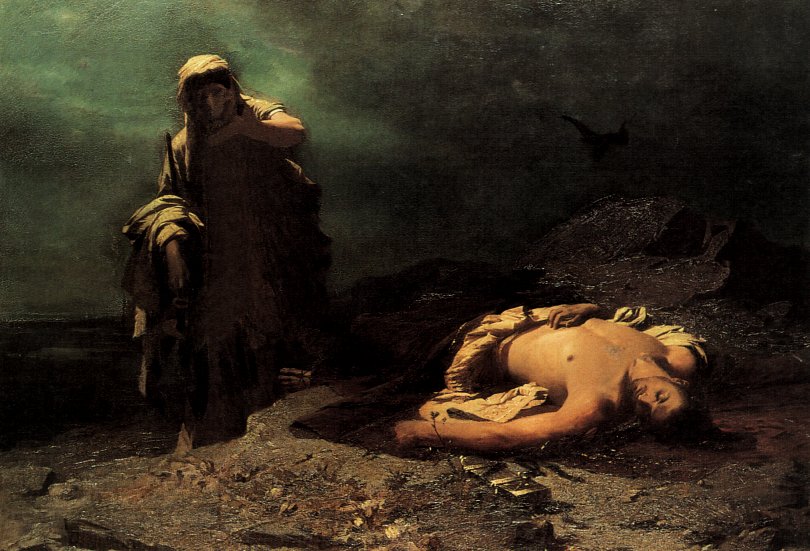
Antigone in front of the dead Polynices by Nikiforos Lytras.
Available from Amazon
Book Length: 240 pages
The Athenian playwright Sophocles, one of the greatest minds of Classical Greece, won literary immortality with his masterpiece Antigone. For this tragedy has come to define tragedy itself, because it so concretely expresses the essence of tragedy—not a mere series of unfortunate events that fall upon one pitiful character, but a dilemma, a seemingly inescapable conflict with grave implications. The dilemma which confronts the eponymous character of this tragedy is this: either obey Tradition or obey the State.
Either choice presents serious threats to Antigone: if she obeys Tradition and buries her brother, she will be executed; if she obeys the State and heeds King Creon’s decree, she will have disgraced the gods and her family. With her being thus trapped between these two horns and having to embrace one of them, one must examine why she makes the choice which has ensured her status as one of the most beloved female characters in all Western literature.
Antigone chooses to defy Creon, not out of spite or out of a vague desire for liberty, but for this precise reason: to perform the proper burial rites for her slain brother, Polynikes. Her choice then is rooted in an obedience to the higher laws of religion and family. In her refusal to let Polynikes, though he was slain as an enemy of Thebes, to become “carrion for the dogs and birds to tear at” (240)1 outside her walls is an obedience to the domestic religion of the Ancient Greeks: in that faith, for anyone to be deprived of burial—especially one’s own kin—was the worst form of disgrace imaginable.2 Moreover, her act is one of love according to the Natural Law, the law engraved on man’s heart that informs all of the love we owe to our kin. Antigone constantly invokes love and obedience throughout the play to justify her act of considerable daring, as she does to her reluctant sister Ismene:3

I shall bury him myself,
(90-93)
and if death follows, that death will be an honour.
I shall rest beside him, two bound by love,
a criminal sacred to the gods!
If death follows from her act, Antigone reasons that she will be “bound by love” with her brother in eternity and honored by the gods, who, having commanded the burial rites, will see her obedience to their law over Creon’s decree as righteous. Rather than fearing the threat of execution, she is emboldened by it. Not even the presence of the King himself can make her rescind her decision, as what transpires between the obstinate ruler and this lonesome girl is a debate in which, as the translator Edward Alexander explains, the interlocutors “speak to two different ideals with no thought of compromise”.4
It is not that Creon’s ideal—that the ruler ought to be obeyed despite the private reasoning of his subjects—is necessarily wrong; in fact, before he confronts Antigone, one obtains a sense of the reasonableness of that very ideal through his words. Against the idea of the private interest superseding the good of society, he says, “any man who would place a friend / above the good of his own fatherland, / that man, I say, is beneath regard” (210-212).5 He moreover describes anarchy as the supreme evil, for “she lays waste to cities, tears homes asunder, / breaks the allied ranks and throws the spearmen / into headlong rout” (772-775).6
The issue with Creon is that he engages in hubris; he believes that he alone is the ruler of the city, as he asks his son: “Has the city not always belonged to he who rules?” (848).7 He holds that his status as king ought to impel all his subjects to obedience, while he himself need not be obedient to the higher authorities of religion and of nature. And he holds to this belief in spite of the fact that he, as a pagan Greek king, is both a religious and secular ruler—for the Greek and Roman pagans held that to be a king was to be a priest, the highest priest in the city.8
Creon therefore pushes himself—and by extension, his ideal—outside of the boundaries he ought to respect, and thus invites punishment from the gods. Antigone is quite the opposite. She opposes Creon without crossing the boundaries of religion or of nature; in fact, she fights in favor of those boundaries with an obstinacy that matches that of Creon himself:9
ANTIGONE:
Who knows if this deed shall be seen as pious,
as pure by those below?CREON:
Never. Unthinkable.
An enemy does not become a friend in death.ANTIGONE:
Be they friend or enemy, revered or despised,
(593-598)
it is not in my nature to hate the ones I love.
While Creon entirely closes himself to the idea that an enemy can be “a friend in death”, Antigone embraces that very possibility wholeheartedly. She cannot hate those she loves, even if the one she loves in question—her brother Polynikes—died as a traitor who led a foreign army against her house’s city. Her nature is noble: for her, love can overcome hate. And this love is not rooted in fluffy sympathy, but in an authentic willing the good of the other.
For Antigone wishes her brother to enjoy eternal happiness, which she, being a pagan Greek, cannot envision happening for him if he is denied the rites of burial. She wills both the good of her brother, and desires to respect the will of the gods, the “unwritten and unfailing, immutable laws” (515).10 In so doing, she resolves the two horned dilemma by preferring to die with love in service of the higher law than to live as a sinner against it. It is all this which makes her the most noble heroine of the pagan Greeks.
Though the religion of the ancient Greeks was laden with many falsehoods, there is common ground that a Catholic can have with Antigone’s cause in favor of it. Both her paganism and our Faith readily admit that the State ought to be subject to transcendent Justice; the difference lies in the exact nature of that transcendent Justice. The longing which Antigone shows for the justice of the gods and their laws in the face of her persecution by Creon was fulfilled by the perfect law which Christ gave to mankind. Unlike the gods of Olympus or of the hearth, Christ is not subservient to, but rather commands, the mysterious force of Fate.
This classic is heartily recommended to the serious student of Western culture. It is a brilliant window into the high culture of Classical Greece—a window which is further opened by Alexander in his excellent explanatory essay “Family & Fatherland”. Thus his edition, which includes this commentary alongside his translation and inclusion of the original Greek text, is the edition recommended for the reader. In an age of profound social alienation and loss of what it means to be a member of a family, Antigone presents a thought-provoking chance to rediscover the meaning of that venerable and most basic of communities.
Sophocles. Antigone. Translated by Edward Alexander. Invictus Publishing. 2023. p. 25.
Coulanges, Fustel Numa de. The Ancient City. Doubleday Anchor Books. 1956. Bk. I, i. p. 17.
Sophocles. Antigone. Translated by Edward Alexander. Invictus Publishing. 2023. pp. 17-18.
Ibid. “Family & Fatherland.” p. 119.
Ibid. p. 24.
Ibid. p. 54.-
Ibid. p. 58. -
Coulanges, Fustel Numa de. The Ancient City. Doubleday Anchor Books. 1956. Book IV, iii. p. 235.
Sophocles. Antigone. Translated by Edward Alexander. Invictus Publishing. 2023. p. 44.-
Ibid. p. 39.