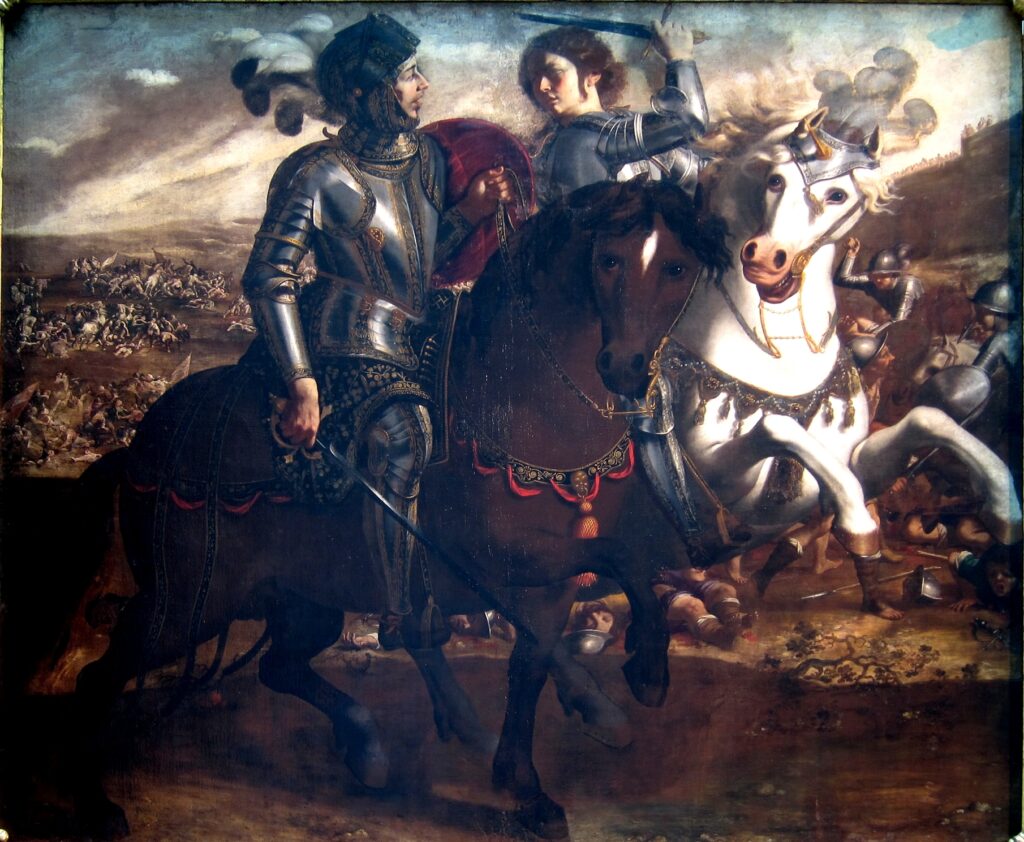
Jérusalem délivrée. Tancrède affronte Clorinde (Palazzo Acquaviva, Conversano).

Available from Amazon.
Book Length: 454 pages.
Here is the Iliad of Christendom, the great epic that the brilliant Italian poet Torquato Tasso bequeathed to us. Sadly almost unknown in the English speaking world in our age, it became very well-known shortly after its publication, and was widely read in sixteenth and seventeenth-century England. In fact, even such enemies of the Church as Spenser and Milton imitated elements of this Catholic epic in their famous works. How revealing—a work the most anti-Catholic of Protestants admired, the liberal-marxists have thoughtlessly tossed aside! This grave omission in our Western cultural story demands rectification. This book, a diamond in the gutter, cries out for our attention; we ought to listen to it, even through the shaky medium of translation.
In writing this work, Tasso sought to create a new epic, a Christian epic that would rival the monumental epics of Antiquity, such as the Iliad and the Aeneid. As Homer and Virgil chose to set their works within the setting of the Trojan War, Tasso selected the First Crusade for his titanic struggle. Given how pivotal the First Crusade was for Christendom, this was a natural choice. Being an artist, Tasso did not view himself as being bound by exact historical facts in the telling of his tale. He makes this apparent to the reader at the poem’s very outset, wherein he requests the poetic Muse to “pardon if my lays / embroidering the truth, seem overgrown, / with pleasures other than your own.” (I. 2).1
Beyond these details, there is a deeper thematic divergence between this epic and its precedents: its concern for the order of charity. The crusaders fight not for the honors of this world, but for God and His Church, though at times they themselves stray from these higher causes. Two of Tasso’s heroes, Rinaldo and Tancred, struggle between the love of romantic desire and the love of God, and these interior struggles result in immense ramifications for the plot. Thus the Liberation of Jerusalem is not only about the battle between Catholics and Mohammedans for Jerusalem, but it is also about the battle between good and evil, grace and sin, in every man.
As the crusaders finally behold Jerusalem, they “scarce dare to lift their eyes” as they behold the sight of “that city where Christ chose to live, / where He died and was buried, and where He / rose again from the dead in glorious majesty” (III. 5).2 Though they have indeed come far, the war for the holy city has just begun. It is a war that not only reaches beyond man to Heaven and Hell (as God and Satan variously intervene throughout the poem to aid the Catholics and the Mohammedans respectively), but it is also a war that penetrates into the very souls of the men fighting it. For from the beginning of this work, the poet informs us that of Godfrey:3
Vainly did Hell oppose him, Asia grim
(I. 1)
vainly combined with Libya, Hell-enticed.
Heaven favoured him and guided back, to fight
under his sacred flag, each errant knight.
With these words Tasso presents us with a realistic, though poetic, moral vision of the First Crusade: a campaign led by a holy lord, but one who must fight a double combat—one against the united armies of the Mohammedan world, and one against the sins and weaknesses of “each errant knight” within his own army. When the beautiful pagan sorceress Armida visits Godfrey’s camp and plays the part of a damsel in distress—the classic romantic trope—her attempt to lure him away from the siege of Jerusalem falls flat. He resists the “pitying passion” which her false story arouses within his “noble heart” (IV. 65),4 and plainly tells her that “pity now would piety undo, / if first we did not give to God His due” (IV. 69).5
Many of the men under his command, however, are not so wise. Using her feminine wiles Armida seduces “untold / thousands of souls” (IV. 96),6 away from their sacred mission, leaving Tasso to comment:7
What marvel then if once Achilles bold
(IV. 96)
and Hercules and Theseus proved Love’s fools,
since now even he who girt on Jesus’ sword
toils in the shackles of that wayward lord?
These “untold thousands” were indeed “Love’s fools”; but of deeper significance are the stories, sung by the poet, of two great crusaders: Tancred and Rinaldo. As with “Achilles bold”, Rinaldo is the warrior destined to deal the fatal blow to the forces of the besieged, but is led astray from the battlefield by romantic passion. Consequently, the process of rescuing this noble, powerful knight from the woeful snare of Armida, a woman who simultaneously echoes Jezebel and Delilah, takes up much activity in the epic’s later cantos. Tancred, though he eschews Armida’s charms, participates in his own personal battle between knighthood and romance. He wars within himself, sensing love for the warrior-maiden Clorinda, his beautiful but fierce enemy, vying for preeminence over the love he has for God, his lord Godfrey, and his band of men.
During a battle early in the poem, Tancred manages to isolate Clorinda and engages her in single combat—but does so to declare his love for her. He, “whom desperate love made free / of fear”, as the poet remarks, speaks “boldly” (III. 27)8 though pathetically to her:9
For I,
(III. 27)
whose heart’s no longer mine, should you decree
it must not live, will gladly let it die:
yours it was long ago; now take it, use it.
Yours it must be, and I will not refuse it.
Thus the crusader loves his enemy—but not in the way that Jesus taught. Tancred’s willingness to lay down his life for Clorinda is entirely self-serving; he wishes to satisfy romantic desire, even if it will kill him, despite the higher cause to which he has pledged himself to.10 He therefore expresses a sensual, self-destructive idea of salvation which is at variance with the ascetic, otherworldly idea of salvation inherent to Catholicism.
Considering that Clorinda is a Mohammedan, this positioning of her as the bait of sensuality to Tancred is especially apt, given that Islam is the religion of carnality. One can readily observe this from the Mohammedan idea of paradise, which entirely contradicts the Christian belief in Heaven. For their heaven is a totally earthly, material haven where gluttony and lust can freely be enjoyed by those who enter it.11
Christianity, on the other hand, is the religion of love because it is the religion of self-sacrifice in the service of God and others. Such can be observed in the Catholic view of Heaven: a wondrous realm where man “shall be delivered from the servitude of corruption, into the liberty of the glory of the children of God” (Romans 8:21); where faith and hope will be fulfilled, and charity shall dwell forever (cf. 1 Cor. 13:13).
The war for the holy land, then, is both a war of Christendom against Islam and a war of knighthood against passion. This being such, the crusaders’ mission to liberate Jerusalem coincides with a mission to order love properly—to make passion serve faith and reason. And it is this latter mission that Tancred struggles with, for it is more difficult to fight against oneself than another.
Out of reverence for this genuine classic, this reviewer will not go further beyond the bounds of the beginning of its story. A taste has been provided here, and it is hoped that the reader will desire the full course of what Tasso offers within The Liberation of Jerusalem, which is highly recommended for the student of Western culture. In particular, the Oxford World’s Classics edition is to be recommended for Anglophone readers, on account of the translator’s ability to capture in considerable respect the rhymed musicality of the Italian original, the helpful notes, and a section dedicated to referencing the many works of art which were influenced by this epic.12 Let us then read then this noble work, and allow it to inspire us with its masterful imaginative depth, heeding the poet’s words:13
(I. 5)
Attend my song and gird yourself for war.
Tasso, Torquato. The Liberation of Jerusalem. Translated by Max Wickert. Oxford World’s Classics. 2009. p. 3.
Ibid. p. 43.
Ibid. p. 4.
Ibid. p. 71.
Ibid.
Ibid. p. 77.
Ibid.
Ibid. p. 47.
Ibid.-
Though Tasso likely had no knowledge of this, the truth that the romantic tradition itself emerged not from the Christian world, but the Mohammedan world, adds greater depth to this conflict. See for reference:
Xavier, Theodore. “Trobadourism: The Idolization of Romance and Its Decadent Consequences, Past and Present.” Parmenidean.is. 7 Aug. 2025.
https://parmenidean.is/wp/?p=7085. -
See for reference this observation by St. Thomas Aquinas:
“He [Mohammad] seduced the people by promises of carnal pleasure to which the concupiscence of the flesh goads us. His teaching also contained precepts that were in conformity with his promises, and he gave free rein to carnal pleasure. In all this, as is not unexpected, he was obeyed by carnal men. As for proofs of the truth of his doctrine, he brought forward only such as could be grasped by the natural ability of anyone with a very modest wisdom.”
Aquinas, St. Thomas. Summa Contra Gentiles, Book I, Chapter 6. Translated by Legio Christi. legiochristi.com. p. 7.
https://legiochristi.com/static/lit/summa-contra-gentiles-LC.pdf. -
For more information about this edition, background information about Tasso, and further analysis of The Liberation of Jerusalem, the following video is recommended:
Classical Poets Society. “Torquato Tasso: From ‘King of Poets’ to Forgotten Classic – Ep 8.” YouTube. 10 Nov. 2023.
https://www.youtube.com/watch?v=oOoeozJXUVU.
Tasso, Torquato. The Liberation of Jerusalem. Translated by Max Wickert. Oxford World’s Classics. 2009. p. 4.