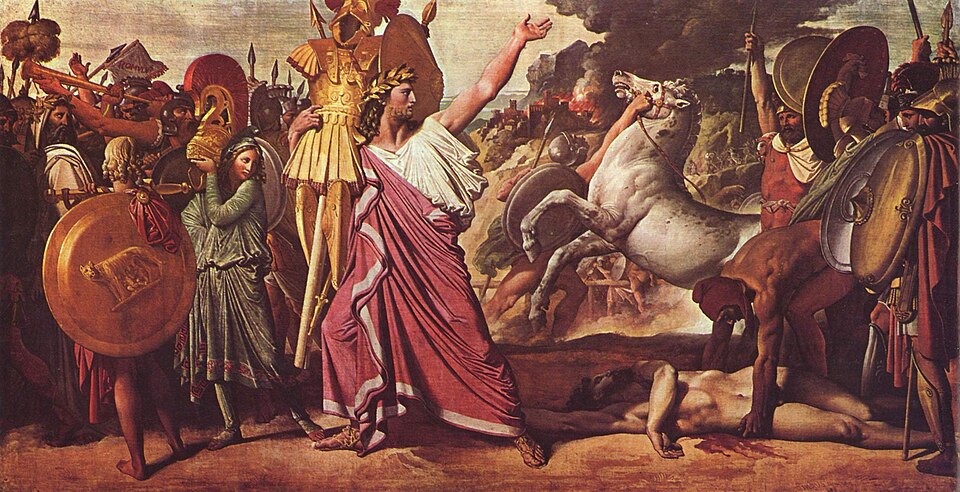
Romulus’ Victory Over Acron by Jean-Auguste-Dominque Ingres (1811). Louvre, Paris.
The Birth of the City
The formation of the city was in itself a religious act: the founder, after consulting the gods to select the proper site, was required to perform a ritual of foundation to purify the soil.1 Involved in this ritual was a union of tribes, phratries, and families who, as the historian describes, “never failed to light a sacred fire, and to adopt a common religion” (127)2 when founding a city. The institution of the city was governed by the same laws which preceded it in the prior institutions of the tribe, phratry, and the oldest of them all, the family.3
For the new city, the founder assumed the same role that the father of the family possessed: the high priest who offered prayer and sacrifice, and in whom authority was vested. While the father, however, only held religious and legal authority over his own family, the founder wielded the authority of both spheres over the city.4
The Kings and Gods of the City
The descendants of the founder became the kings over the ancient cities. Though the religious authority of the king was considerable, his authority in that domain was not absolute; his power merely overlaid the lower, elder priesthoods. Much in the same manner, his political authority was constrained in considerable respect by the civil authority that these priesthoods possessed. As Coulanges points out, such an arrangement of power bears similarities with another period in history:5

(235)
Like the feudal king who had as subjects only a few powerful vassals, this king of the ancient city commanded only the chiefs of the tribes and the gentes, each one of whom might be individually as powerful as he, and who, united, were much more powerful.
These ancient monarchies, as with the feudal monarchies of the Middle Ages, operated with a hefty amount of political subsidiarity. There is, however, a notable difference to be pointed out regarding the function of kingship in both eras. In the Middle Ages, the Church and the State governed the spheres of religion and politics respectively in a complementary manner, while in the ancient world these two spheres were one and the same.
Consequently, it should be no surprise that the ancient cities did not profess the modern belief of “freedom of religion”—an error that was (and still is) grafted onto them by the dishonest or misinformed. In a social structure that was entirely defined by religion, there was no other alternative: the refusal to commit oneself to the common bond of the deity or deities of one’s city was both treason and impiety. Expounding these conditions further, the author writes:6
A man had no chance to choose his belief. He must believe and submit to the religion of the city. He could hate and despise the gods of the neighboring city. As to the divinities of a general and universal character, like Jupiter, or Cybele, or Juno, he was free to believe or not to believe in them, but it would not do to entertain doubts about Athene Polias, or Erechtheus, or Cecrops.
(222)
The “divinities of a general and universal character” were the product of mystery cults or poetic imagination; the gods of the city were the product of lineage. As with the family, the phratry, and the tribe, a common worship was therefore necessary for the city partake in. Of the social import of these rituals, Coulanges makes mention that:7
(Ibid)
Men had to conform to all the rules of worship, figure in all the processions, and take part in the sacred repasts. Athenian legislation punished those by a fine who failed religiously to celebrate a national festival.
It was not in the mere profession of a belief by which one affirmed one’s loyalty to the cities. There was, in fact, a rigor to their religions. While they lacked exact doctrines, they were established upon a firm idea—that the patron gods or goddesses had favored the founder, and had therefore made possible the creation of the society he inaugurated. But the religious festivals and sacrifices offered to divine patrons were not merely references to the past: they were a continual invocation and supplication of the deities, for it was believed that if the city lost favor in their eyes, they would refuse to aid it in the hour of need.8
The god or goddess was then perceived as the central figure in the life of the city. They assumed a role that was simultaneously religious and political, a role which resembled that of the kings who offered prayer to them.
The Ancient Class War
As the social foundations of the Indo-European life were rooted in lineage and the common bond of a shared religion, anyone excluded from the religion of his people was to be despised as an outcast. This was what initially gave the plebeians their low status in the civilizations of ancient Greece and Rome, as the author remarks: “One word characterizes these plebeians — they were without a hearth; they did not possess, in the beginning, at least, any domestic altars” (232).9
It was not an economic inferiority to the patricians, but rather a religious one that determined their social value. The plebeians lacked hearths for a variety of reasons: they could have been the children of those who had been married without the rites; their parents could have been negligent in transmitting the observances of their cult to them; or, on account of serious crimes, they were forsaken from imploring the gods of their fathers.10 They were without rites; thus they had no rights.11 For several centuries Rome did not even count the members of this class as forming a part of the Roman people.12
Eventually, this class grew to be quite numerous in the cities, and were no longer persuaded by the religious beliefs which once held sway over them. Since the ancient religion had no means of reconciling this class to itself, the vast divergence between the interests of the patricians and plebeians brought about a class war that would ultimately undermine the world that the city had been founded upon.
In order to gain for themselves a more dignified existence, the plebeians aligned themselves with the kings, who in turn were happy to enlist their support against the patricians. The aristocracy bitterly resisted this threat to their position, and more than this, their religion: Coulanges writes that in their view, “the kings were odious enemies, who, to augment their own power, were planning to overthrow the sacred organization of the family and of the city” (245).13 They therefore ignited a revolution against the monarchs. Wherever they held enough power to do so, they drove out the kings, or relegated them and their descendants only to the practice of their priesthood.
But all was not lost for the plebeian cause. In time, they found allies in the tyrants—men who, because they were not descended from the kings, ruled only with civil authority. However, the rule of the tyrants did not last, despite their successes in expelling the aristocracy from many cities.14
A long term solution for the plebeians came about by means of another development. They found work in various trades, and were greatly aided by the creation of money. For the coin, as the author notes, “was not subject to the same conditions as landed property…[it] could pass from hand to hand without any religious formality” (273).15 In the face of the economic ascendancy of the plebeians, the patricians were forced in time to first compromise and then loosen their grip upon society. This transition was a gradual one, and it marked the shift from a society based solely upon religious association to one that rested upon the preservation of the state. While the resulting order solved some of the issues which had plagued prior generations, it produced its own series of crises.
New Crises Arise
These crises were religious, philosophical, and political. The Milesian philosophers and their successors throughout the Hellenistic world presented one set of challenges to the domestic cult; the poets presented another. Describing the work of the latter, Coulanges writes:16
Poets went from city to city, and taught men, instead of the old hymns of the city, new songs, wherein neither Lares nor city-protecting divinities appeared, and where the legends of the great gods of heaven and earth were related; and the Greek people forgot their old domestic and national hymns for this new poetry, which was not the daughter of religion, but of art and of a free imagination.
(354)
The Sophists similarly roamed about from city to city, with a teaching that contradicted the old religion in its own respect. As the author notes, they went about proclaiming “a new justice, less narrow, less exclusive than the old, more humane, more rational, and freed from the formulas of the preceding ages” (355).17 Though they had no unity of doctrine themselves and were often met with hostility, they were quite effective in undermining the principles of the old religion. The Roman conquest of Italy and Greece only weakened the particularist religious mentality of the ancient city even further, rendering it practically irrelevant, though its sentiments continued to affect political and social life.18
By the time that Jesus Christ came, there had already been a substantial history of this religion being attacked within the societies which it had brought into existence. Challenging the domestic cult was nothing new; Coulanges summarizes much when he comments that, “from the fifth century onwards, reflecting men freed themselves from [its] errors” (353).19 Though reflecting men did free themselves from it, they themselves became torn on the questions of the soul and the afterlife. While Plato, Aristotle, and Cicero could either offer only silence or speculation upon these matters, Christ went forth and boldly declared His doctrine.
How Christ Changed the City
Christ, through His doctrine and crucifixion, showed the descendants of Indo-European man an entirely revolutionary conception of worship—one based upon the love of God. He thus presented the greatest offer of spiritual freedom to this race from the burden of the errors which their priests, philosophers, and poets had stumbled into over the course of millennia. And though the author of this work does not reveal himself to be of an orthodox attitude, he comments on this point in his own way, writing the following:20
Christianity changed the nature and the form of adoration. Man no longer offered God food and drink. Prayer was no longer a form of incantation; it was an act of faith and a humble petition. The soul sustained another relation with the divinity; the fear of the gods was replaced by the love of God.
(391)
“Mercy and truth have met each other: justice and peace have kissed” (Psalms 84:11). Christ came to bring the truth to all nations, and for the descendants of the Indo-Europeans, He breached the spiritual gap that the centuries of the domestic religion had wrought. He struck the final blow to the narrow rules of the old religion, and set these people free from the uncertainties about the afterlife which had plagued them.
With the introduction of the New Law, He perfected whatever had been good within this old law of the Aryans, such as its hatred of adultery and murder, and its love of the family. And though His Church survived three centuries without the support of the State, this does not imply that there could be no true union between them, as the author seems to indicate in one place.21 That historical circumstance merely demonstrates that though it is better to have a union between Church and State, the operation of the Church does not require the sanction of the State, for it is a kingdom not of this world (cf. John 18:36).
Conclusion
This is an essential book to read in order to begin to understand the ancient world. It is therefore heartily recommended to the student of history. Coulanges writes with the skill of both the erudite scholar and the artist in this work, which makes a reading of the dim past which he unveils within it all the more enjoyable. Take up this work, and discover herein something of the true story of the first societies.
Previous: The Ancient City (Part I)
Coulanges, Numa Fustel de. The Ancient City. Doubleday Anchor Books. 1956. Book III, iv. pp. 134-137.
Ibid. Book III, iii. p. 127.
Ibid.
Ibid. Book III, v. p. 142; Book III, ix. pp. 174-177.
Ibid. Book IV, iii. p. 235.
Ibid. Book III, xvii. p. 222.
Ibid.
“Every city looked to its gods for safety. Men invoked them in danger, and thanked them in victory. Often defeat was attributed to them; and they were reproached with having badly fulfilled their duty as defenders of the city. Men even went so far, sometimes, as to overturn their altars and stone their temples.Ordinarily, these gods took good care of the city whose worship they received; and this was quite natural: these gods were eager for offerings, and they received victims only from their own city. If they wished the continuation of the sacrifices and hecatombes, it was very necessary that they should watch over the city’s safety.”
Ibid. Book IV, ii. p. 232.
Ibid. Book IV, ii. p. 231.
Ibid. Book IV, ii. p. 233.-
Ibid. Book IV, ii. p. 230.
Ibid. Book IV, iii. p. 245.-
Ibid. Book IV, vii. p. 271.“The appearance of this word [tyrant] in the Greek language marks a principle which the preceding generations had not known—the obedience of man to man. Up to that time there had been no other chiefs of state than those who had been chiefs of religion; those only governed the city who offered the sacrifices and invoked the gods for it.”
Ibid. Book IV, vii. p. 273.
Ibid. Book V, i. p. 354.
Ibid. Book V, i. p. 355.
See for reference this excerpt from a speech attributed to Augustus Caesar:“Indeed, it was never permitted to any man, even in olden times, to neglect marriage and the begetting of children; but from the very outset, when the government was first established, strict laws were made regarding these matters, and subsequently many decrees were passed by both the senate and the people, which it would be superfluous to enumerate here. I, now, have increased the penalties for the disobedient, in order that through fear of becoming liable to them you might be brought to your senses; and to the obedient I have offered more numerous and greater prizes than are given for any other display of excellence, in order that for this reason, if for no other, you might be persuaded to marry and beget children.”
Dio, Cassius. Roman History. 56.6. Translated by Ernest Cary. Lexundria.
https://lexundria.com/dio/56.6/cy.
Ibid. Book V, i. p. 353.
Ibid. Book V, iii. p. 391.
Cf. Ibid. Book V, iii. pp. 393-394.