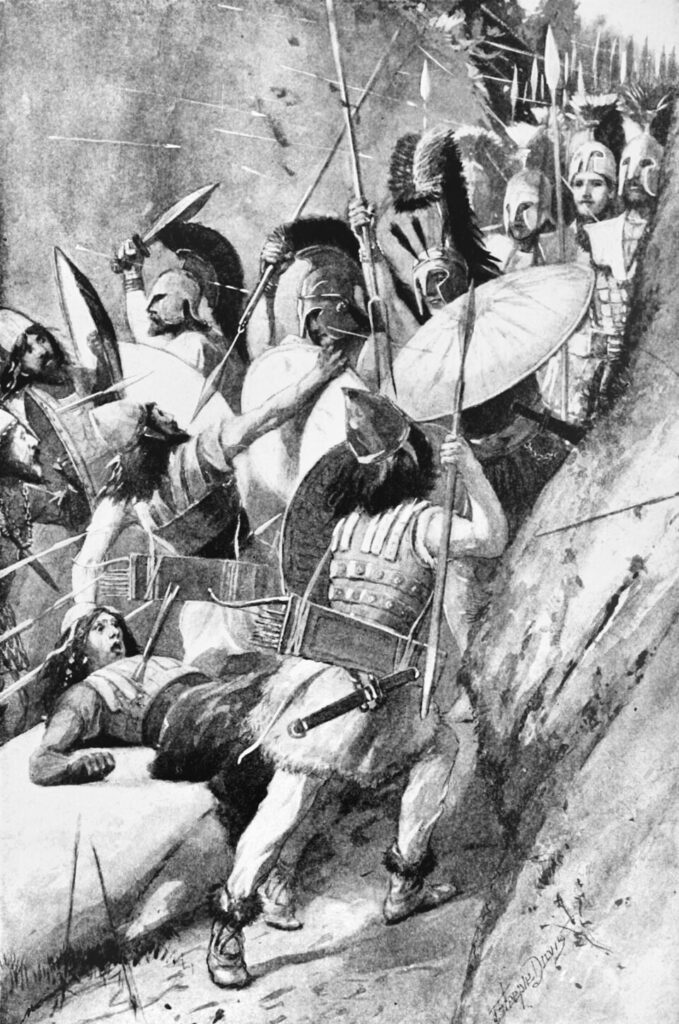
Scene from the Battle of Thermopylae by John Steeple Davis.
Available from Thriftbooks, Abebooks, and Amazon (Penguin Classics)
Available from Abebooks and Amazon (Landmark)
Book Length: 784 pages (Penguin) or 953 pages (Landmark)
The art of historical writing began with two men: Moses and Herodotus. Moses, inspired by the Holy Ghost, was the first author of sacred history; Herodotus, merely inspired by his own intelligence and inquiry, was the first author of secular history. Rightly has the latter been called the “father of history” by Cicero—for he deserves his place as the father of the Western historical tradition. Though Herodotus was a considerably better storyteller than a conveyor of literal fact,1 historians still follow in his footsteps whenever they rely on documents and interviews to construct a historical narrative.
As for the narrative which Herodotus has bequeathed to ourselves in The Histories, so influential has it been that several key moments from its grand, sweeping scope have become deeply ingrained in our cultural memory. Who has not heard that the Spartans, after they were told that the innumerable forces of the Persians would blot out the sun with their arrows, replied that they would be content to fight in the shade? That anecdote, as with many others, comes from Herodotus.2 And though such anecdotes have indeed taken a life of their own apart from this work, viewing them within Herodotus’ overarching narrative rewards one with deeper insight of the roots of the West.
Herodotus begins his inquiry into the causes of the epic Greco-Persian Wars with an interpretation of the causes of that other, more ancient, titanic war between Greece and Asia: the Trojan War. From the fall of Troy he follows the course of history—though not always chronologically—and presents the reader with his account of the various empires which preceded Persia. The reader is therefore given an account of Lydia, Scythia, Media, and Egypt, which all either receded to Persia’s expansion (as in the case of the Scythians) or submitted to it. Throughout this process, Herodotus indicates that the involvement of God is the decisive factor in history.

So irresistible is the force of God within history that, as the ancient historian has a Persian soldier much later in the text remark, “what God has ordained no man can by any means prevent” (IX. 16).3 The God of Herodotus, however, is not the Catholic God. For the author, as with the rest of pagandom, only murkily understood the very basics of what and who God is. To prove divine involvement in his narrative, Herodotus often gives credibility to a variety of oracles, dreams, and omens, for he posits these as being the means by which God forewarned various rulers of the impending disasters which were to come from their hubris. Evidently, the Catholic cannot give credibility to such sources. Moreover, while the ancient historian seems to recognize God as being a just punisher of evil, he also insinuates that God punishes man merely to preserve His own glory from any human challenger.
Observe his seemingly conflicting statements on God. Firstly, he expresses through Solon, one of the Seven Sages of Greece, that “God is envious of human prosperity and likes to trouble us” (I. 32).4 Then, through the Persian advisor Artabanus he states, “it is the great ones that God smites with his thunder, nor does he allow them to show off” (VII. 10c).5
The True God is indeed jealous—but not because He feels threatened by the “great ones” of the earth, and so reduces them to arbitrarily preserve His own power. That sort of thinking is appropriate to Zeus, who in Hellenistic myth punished Prometheus for precisely this reason. But it is not proper to Christianity, for the jealousy of God is such because He is Being; thus he is zealous to the highest degree, and so is Zeal just as He is Love. For as St. Thomas says that zeal “arises from the intensity of love.”6 The jealousy of God is not selfish: it is a zeal which opposes whatever diverts man from Himself, the Good, in the highest degree.
Fortune, moreover, changes hands not out of a divine arbitrary whim, but because it is subject to Providence, which orders these changes ultimately to punish sin and hubris and for the good of souls. The visions of the prophet Daniel, some of which concern the rise of Persia that Herodotus also discusses, is proof of this matter (cf. Daniel 7:1-5; Daniel 11:1-2). Thus what Daniel was able to perceive clearly through the light of faith, Herodotus saw quite dimly. Yet the ancient historian still saw something divine at work in this historical process, and thus even through his inquiries one can see that God punishes rulers who fall to their own hubris.
Of such rulers, one especially noteworthy example is that of the Lydian king Croesus. Upon hearing from the Oracle of Delphi that he would destroy a powerful kingdom if he made war with Persia, Croesus rushed to war in haste and ended up fulfilling the prophecy—by destroying his own kingdom. Painting a picture of the defeated king beside himself, a captive within his own palace, Herodotus offers the reader this striking exchange:7
For a while Croesus was deep in his thoughts and did not speak. Then he turned, and seeing that the Persians were sacking the town, said: ‘Should I tell you, O king, what I have in my mind, or must I now keep silent?’ Cyrus replied that he might say what he pleased without fear, so Croesus put another question: ‘What is it,’ he asked, ‘that all those men of yours are so intent upon doing?’
‘They are plundering your city and carrying off your treasures.’
‘Not my city or my treasures,’ Croeseus answered. ‘Nothing there any longer belongs to me. It is you they are robbing.’
(I. 88)
Such then is the mutability of worldly goods: what were once one man’s goods can swiftly become those of another, even to the ignorance of the very man who has newly acquired them. In moments such as these, Herodotus is at his finest. He shows us that humiliation is the fruit of hubris, for the hubristic man is the one who overextends himself beyond what he is given; thus he must be brought low and made small.8
The greatest example of hubris in The Histories is that of the Persian king Xerxes, who believed himself destined to conquer Greece—and after Greece, the world. For it was his ambition to “extend the empire of Persia that its boundaries shall be God’s own sky” (VII. 8c)9 which drove him to order this invasion, thus initiating a titanic struggle to rival that of the Trojan War. He even explicitly named Europe as a target of his grand design, for as he declared to his council: “With your help I shall pass through Europe from end to end and make it one country” (Ibid).10 In crossing the Hellespont, Xerxes became the prototype of all future Oriental despots who would seek to bend the Occident to their will.
It was, as Herodotus himself presents it, a clash of civilizations: the proto-West, embodied in the small Greek city-states and their Hellenic League, defending themselves against the colossal empire of Persia and her subjects. Between the two sides there were many disparities. In terms of numbers, the Persians evidently were vastly superior; in terms of discipline and resolve, the Greeks outmatched them.
Through the perspective of Demaratus—a Spartan prince, who, having been exiled from his homeland, joined the Persian side, Herodotus grants us insight into why the Hellenic spirit prevailed. Speaking to Xerxes, the Spartan tells him that Greece’s lack of material riches is not a weakness, but a strength. In fact, her poverty afforded her the ability to prize wisdom and valor over luxury. For he says:11
[P]overty is Greece’s inheritance of old, but valour she won for herself by wisdom and the strength of law. By her valour Greece now keeps poverty and despotism at bay.
(VII. 102)
Freedom and valor are thus mutually united in the Greek polis, tempered by necessity. It is this nobility which made the Spartans in particular so courageous, as Demaratus remarks to Xerxes that:12
They are free – yes – but not entirely free; for they have a master, and that master is Law, which they fear much more than your subjects fear you.
(VII. 104)
It is this master, Law, that commands what the ancient historian considers “the most important in human affairs” (IV. 46):13 the preservation of one’s race, one’s people. It is this Law which gave to the world the immortal example of Thermopylae, a defeat more glorious than victory; a defeat which inspired the contemporary Greeks to their final triumph; a defeat which has continued to inspire countless generations of Europeans ever since. And indeed, it inspires men today, and will continue to inspire men so long as there are men.
Herodotus is therefore an essential author to study for the serious student of Western history. The Histories themselves, as with the Greco-Persian Wars they investigate, remain a source of inspiration to Western man; a source that has lost none of its vitality despite the passage of millennia. Moreover, it will surely come as a relief to the reader that the first historian of secular history happens to be one of the most engaging historians to have ever written. The editions especially recommended for reading are the Penguin Classics edition and The Landmark Herodotus. Bear with the gold-digging ants, and you will be amply rewarded!
See for reference what Herodotus admits of himself:“My business is to record what people say, but I am by no means bound to believe it—and that may be taken to apply to this book as a whole.”
(VII. 152)
Herodotus. The Histories. Translated by Aubrey de Sélincourt. Penguin Classics. 2003. p. 468.
“Of all the Spartans and Thespians who fought so valiantly the most signal proof of courage was given by the Spartan Dieneces. It is said that before the battle he was told by a native of Trachis that, when the Persians shot their arrows, there were so many of them that they hid the sun. Dieneces, however, quite unmoved by the thought of the strength of the Persian army, merely remarked: ‘This is pleasant news that the stranger from Trachis brings us: if the Persians hide the sun, we shall have our battle in the shade.’”
(VII. 226)
Ibid. pp. 494-495.-
Ibid. p. 560.
Ibid. p. 15.
Ibid. p. 419.
Aquinas, St. Thomas. Summa Theologiae I-II, Q. 28, Art 4.
https://drbo.org/summa/question/14704.htm.
Herodotus. The Histories. Translated by Aubrey de Sélincourt. Penguin Classics. 2003. p. 41.-
There are indeed similarities between the Greek idea of hubris to the sin of pride, but they are not two names for the same fault.
Ibid. p. 417.
Ibid.
Ibid. p. 448.
Ibid. p. 450.
Ibid. p. 255.