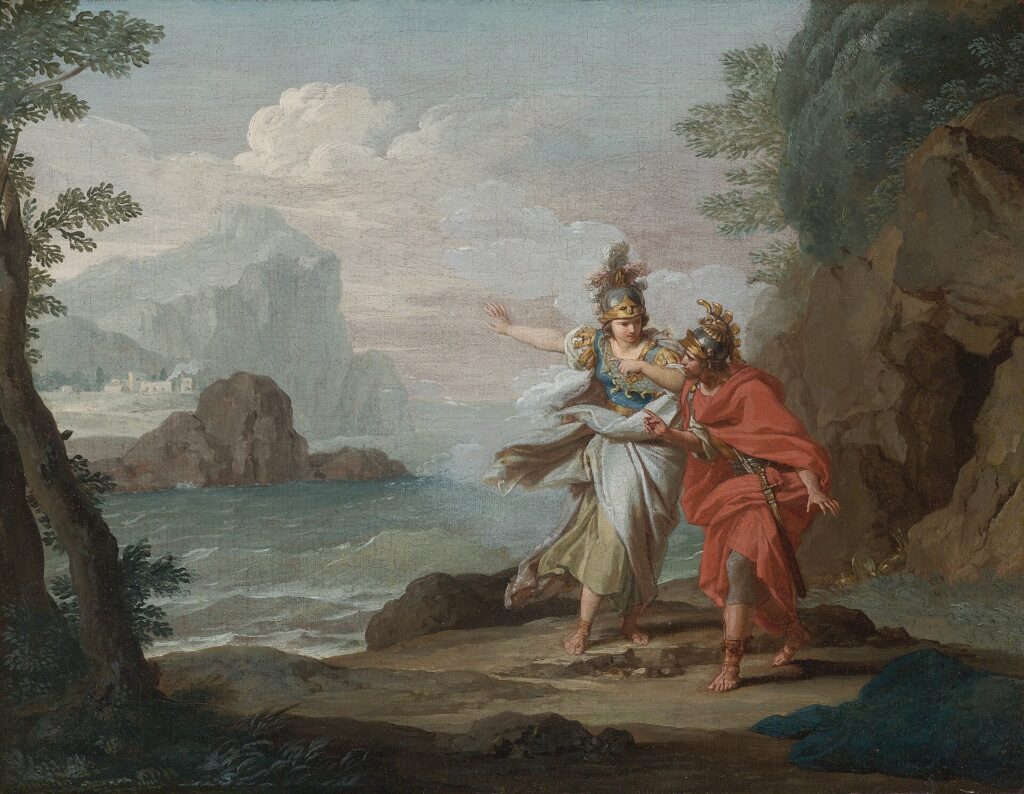
Athena appearing to Odysseus to reveal the Island of Ithaca by Giuseppe Bottani.
Available from Amazon.
Available from Imperium Press (Bryant translation)
Book Length: 374 pages (Lattimore) or 799 pages (Bryant)
The Odyssey undoubtedly stands as one of the giants in the Western Canon; it is the giant, if we may term it, of the adventure genre. As the first great adventure story, Homer’s immortal sequel to the Iliad is replete with the now standard elements of the genre: fearsome monsters, strange lands and peoples, superhuman trials, and a central hero who overcomes them all.
But the joy of the adventure is not fulfilled in any of its eccentric parts—it is fulfilled in as a whole that returns the hero home. It is Homer’s voice, through Odysseus, who reminds us of this truth so many centuries later, and the force of his artistic power in conveying it has granted to his work a literary immortality that few adventure stories since the Odyssey have matched.
In his struggle to return to Ithaca, his homeland and kingdom, Odysseus faces opposition from various beings who seek to impede him. Aside from Poseidon, the most notable of these are Polyphemus, Circe, and Calypso. Both Circe and Calypso are minor goddesses; they attempt to detain Odysseus that they may gain him for a companion. Their feminine wiles try Odysseus’ loyalty to his wife Penelope, but their attempts to ruin him are foiled. Neither of their idyllic islands can usurp the irreplaceable place of love that his island of Ithaca holds in his heart, and neither can these goddesses, beautiful though they are, usurp the love which Odysseus holds for Penelope.
While, however, Odysseus is merely detained by the Circe and Calypso, the brute Polyphemus attempts to outright destroy him. And though the hero’s wits serve him well to escape Polyphemus, it is after he has beaten the cyclops that he errs, his pride getting the better of his reason despite the warnings of his men. Yielding to that which he terms “the anger of my heart” (IX. 501),1 he wastes the ingenious trick of giving his name to the ruthless cyclops as “Nobody”, and jeers:2

Cyclops, if any mortal man ever asks you who it was
(IX. 502-505)
that inflicted upon your eye this shameful blinding,
tell him that you were blinded by Odysseus, sacker of cities,
Laertes is his father, and he makes his home in Ithaka.
By revealing his identity, Odysseus makes it possible for Polyphemus to call down the wrath of Poseidon upon him and the other survivors—something that would not have happened had the hero been content to remain anonymous. Thus it is not only against monsters and goddesses that he must contend with on his journey, but also himself.
Man has the potential to be his own adversary in any undertaking, whether epic or not. Indeed, Odysseus made the wrong choice as he sailed away from the Cyclops’ cave, but it is one that ought to be quite understandable to ourselves.
Odysseus fails in other moments during the Wanderings. When Circe tells him of what he must do to pass between the ill-fated waters governed by the monsters Scylla and Charybdis, he resists the idea that he must sacrifice six of his men by sailing towards the six-headed Scylla to avoid the greater ruin of having his vessel entirely sunk by Charybdis’ whirlpools. He inquires if there is “some way” (XII. 114) he can both “escape away from deadly Charybdis, / but yet fight the other one off” (XII. 114-115). To this hero’s expression of his noble desire to save all his companions, the sorceress Circe can only ask in bewilderment: “Will you not give way even to the immortals?” (XII. 117).3
But when the voyage through that terrible cave comes, he refuses Circe’s request to remain unarmed. Despite his preparation, his “glorious armor” (XII. 228), and his “two long spears” (XII. 228-229), the hero is taken by surprise when the beast lashes out and, as was foretold to him, devours six of his men. Increasing his grief when he tells the story of his Wanderings to the Phaiakians, he describes these six men as “the best of them for strength and hands’ work” (XII. 246),4 and laments how:5
I saw their hands and feet from below, already lifted
(XII. 248-250)
high above me, and they cried out to me and called me
by name, the last time they ever did it, in heart’s sorrow.
As clever and strong as Odysseus is, there are forces far beyond his power to overcome. This is a truth conveyed throughout the epic, but it is perhaps here that he is made to feel it most acutely.
With the Scylla and Charybdis episode being only one among many painful events for the hero, it begs the question: do the gods, the greatest of the forces beyond Odysseus’ power, hate him? Throughout the Odyssey, the reader is made to know certain doings of the Olympian gods that are never disclosed to its eponymous hero; in the very first book, they hold a council, with Zeus as its head. Casting his gaze upon the earth, he declares:6
Oh for shame, how the mortals put the blame on us
(I. 32-34)
gods, for they say evils come from us, but it is they, rather,
who by their own recklessness win sorrow beyond what is given.
According then to Homer, it is not the gods who create misfortune—it is man. For Zeus declares that men “by their own recklessness win sorrow beyond what is given.” But if by recklessness man can “win sorrow beyond what is given”, sorrow is still given to mortal man as an inevitability. Man cannot avoid it; he can, however, increase it. The gods are therefore not benevolent, but they are not entirely malevolent either.
Since the gods are themselves incapable of concord and lack essential goodness, they do not act to bring man into harmony with the Good. As these beings did in the Iliad, they selfishly intervene in the affairs of men to extend their Olympian conflicts upon the earth; but if men act foolishly on their own account, they will reap evils of their own doing. Poseidon, a deity who cares more for the prayers of a wicked son than those of a good man, may rush to the aid of Polyphemus, but it was Odysseus who occasioned chastisement by recklessly revealing his real name to the monster. It may be fated for Scylla to consume men aboard any ship that veers close enough to her, but Odysseus incurred greater sorrow because he believed he could stop this from happening and attempted to do so.
Despite Odysseus’ failures and his various external opponents, he perseveres in his journey. What animates him, as Athena divines, is the love of his hearth. From the heights of Olympus she sees him on Calypso’s beautiful secluded island “straining to get sight of the very smoke uprising from his own country”(I. 58), but also perceives that he “longs to die” (I. 59) because the hero loses faith that he will ever enjoy that sight again.7
Yet his despair does not last long; when he is provided the means to escape, he does so, knowing full well the dangers that may await him on the Ocean. He throws away a possible immortal life of ease with Calypso because love impels him home to his wife and son. Love for Odysseus—and happiness with it—is to be found at home, not in glory or goddesses.
Homer illustrates this idea of love even further when he sings of Odysseus’ visit to the shores of the dead. The living hero meets the departed heroes of the Trojan War, namely Achilles, Agamemnon, and Ajax, but their fame and strength upon earth bear no fruit in reducing their misery here. In a particularly touching moment, Odysseus attempts to console the ghost of the great Achilles, for he tells him:8
Achilleus, / no man before you has ever been more blessed than you, / nor ever will be…Do not grieve, even in death, Achilleus.
(XI. 482-486)
Achilles is however not moved, as he gives the hero this reproof:9
I would rather follow the plow as thrall to another
(XI. 489-491)
man, one with no land allotted him and not much to live on,
than be a king over all the perished dead.
Thus Achilles, the most glorious of all the Greek warriors, would trade places with a miserable slave than to be resigned even to the fate of “a king over all the perished dead”. And his view is quite sensible, given the portrayal of the afterlife within this work—all alike appear condemned to misery, regardless of how good or evil they were.
If misery is the fate of the dead Greeks who fought the Trojans, then the fate of those Greeks who survived their return is happier. But while these veterans may have brought home earthly treasure, Homer indicates that their better treasure is that of life itself. For when Odysseus’ son Telemachus goes with a companion to visit King Menelaus, the man who won Helen back from Troy, the victor declares before his guests the emptiness of the incredible assortment of goods that accompanied him and his wife home.
While they are dined by Menelaus, the companion invites Telemachus to imbibe the luxury of their host’s adornments, namely, “the gleaming of the bronze through all these echoing mansions, the gleaming of gold and amber, of silver and of ivory” (IV. 72-73).10 Catching these whispers of admiration, he tells them both of the sufferings of his journey and declares:11
So it is with no pleasure that I am lord over all these possessions.
(IV. 93)
He continues further, and laments:12
I wish I lived in my house with only a third part of all
(IV. 97-99)
these goods, and that the men were alive who died in those days
in wide Troy land far away from horse-pasturing Argos.
Menelaus, despite being the victor of the Trojan War, cannot have this wish fulfilled. Gladly would he trade the majority of his spoils to bring back the men who perished fighting for his cause, but alas, he cannot resurrect them. For all their beauty, the glittering of the rare minerals he has decorated his “echoing mansions” with cannot expel the remembrance of his slain allies from haunting his mind. Neither worldly glory nor material wealth can truly satisfy the greatest of Homer’s kings, and therefore they cannot satisfy the desires of Homeric man.
The Homeric view of happiness can essentially be summarized in those magnanimous words of John Ruskin: “THERE IS NO WEALTH BUT LIFE.”13 There is no happiness for the departed in the Homeric vision; thus only in life can man possess it. But in life, not all things lead to happiness.
Homer uses Menelaus’ regret and Achilles’ sad fate to teach his reader that neither material wealth nor even martial glory can grant it. What makes man happy then is not combat, not possessions, but the joy of living in his homeland surrounded by his family. It is this theme that explains the terrible fate of the suitors: for if happiness lies in homeland and family, then those who violate these, as they do, deserve no remorse. Odysseus’ quest to reclaim this joy in spite of the vast array of his opponents, from these ingrates, monsters, goddesses, and the Earth-Shaker Poseidon elevates the Odyssey beyond the simple thrills and action that conventional adventure stories rely upon, imbuing it with a higher morality.
The Odyssey then comes down to ourselves as not only a foundational element of our literature, but also a rigorous poetic defense against the artifices launched against the family and the homeland common at present. Homer’s exaltation of value of family and homeland above worldly honor and riches is certainly contrary to the materialistic spirit of bourgeois modernity. His view of man appeals to our human nature, for man was meant to love the goods of family and home and take pleasure in them.
The joy that we derive from these goods was only elevated by the Coming of Christ. The selfishness of the Olympian gods was forever vanquished by the selflessness of Jesus Christ, true God and true man, who has prepared mansions in Heaven for all who love Him (cf. John 14:2). As the erudite scholar Fustel de Coulanges pointed out, by this change “the fear of the gods was replaced by the love of God.”14 Furthermore, the cruel deceit of a miserable afterlife for all men was overthrown through the power of the Cross, for by it Christ rendered man’s entry into the blissful abode of Heaven possible. By founding His Church, He has offered to man participation in a spiritual family, a family that is both in this world and beyond it.
In short, the happiness in life that Homer proposes has been perfected by the life of Christ. Homeric man became Western man. This process was not exclusive to the Greece of the Roman Empire, for it had analogous cases throughout Europe, as saints and scholars together forged Western civilization from the ruins of Greco-Roman civilization. And though many have attempted to obscure or distort this truth, the mark that Christ has left upon Western man—like baptism itself—is indelible.
This epic then, though written centuries before that great spiritual transformation came about, is well worth reading. If one cannot read Homer in the original Greek, the Bryant and Lattimore translations are both quite respectable, though sound translations of the Odyssey are not limited to these two. Read the words of this great poet and imbibe them; let him inspire you. Go forth, Western man, and venture with Odysseus to reclaim what is rightfully yours.
The Odyssey of Homer. Translated by Richmond Lattimore. Harper Perrenial Modern Classics. 2007. p. 150.
Ibid.
Ibid. p. 188.-
Ibid. p. 191.
Ibid.
Ibid. p. 28.
Ibid.
Ibid. p. 180.
Ibid.
Ibid. p. 67.
Ibid.
Ibid.
Ruskin, John. Unto This Last. “Ad Valorem.” 1860. Wikisource.
https://en.wikisource.org/wiki Unto_This_Last_(Ruskin)#Ad_Valorem.
Coulanges, Fustel de. The Ancient City. Bk. V, iii. p. 391.