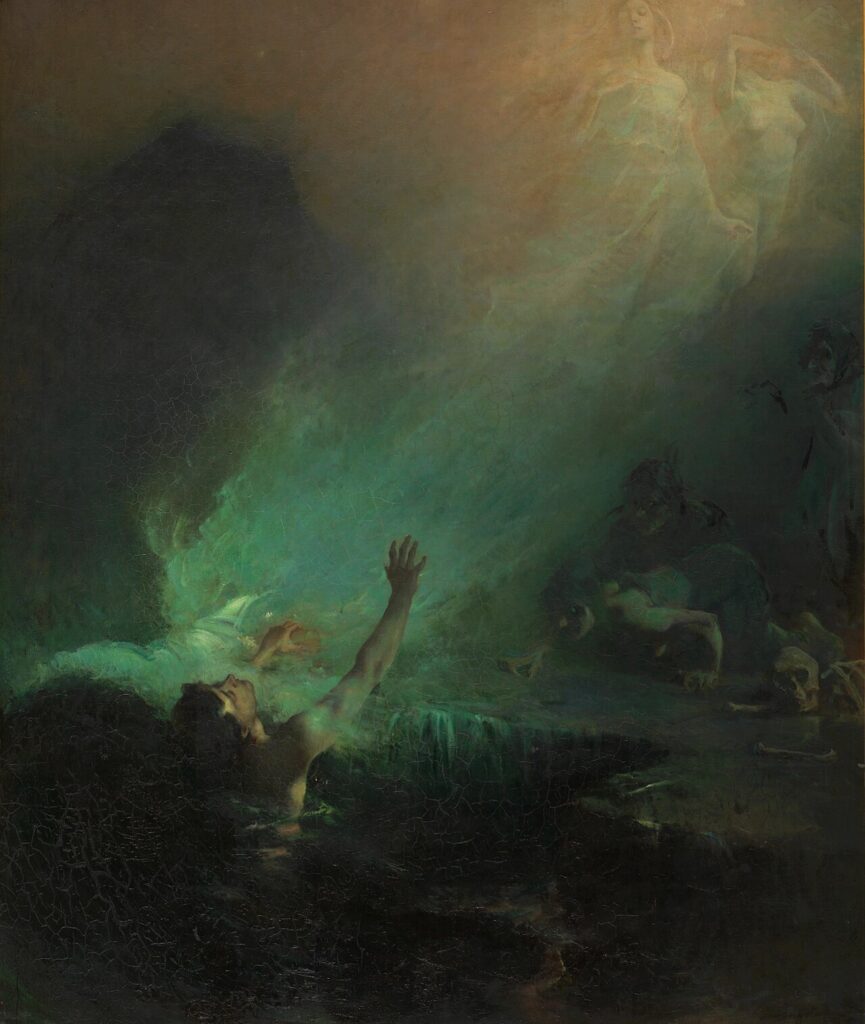
The Sirens by John Longstaff
The Problem that the KIDS Act Presents
Though it has yet to become law, the recent passage of the Kids Internet and Digital Safety (KIDS) Act by the House of Representatives seems to be a positive step in ridding the Internet of pornography here in the United States. But this is far from the truth. This digital prohibition would sacrifice privacy in favor of a flimsy “safeguard” that can easily be circumvented, as presently is the case in the United Kingdom and Australia, where similar age verification legislation has already been in force for some time.

The stated intentions of age verification laws are mostly noble, but further examination reveals these intentions to be full of folly. It is the pretense of those who support this species of legislation that the enactment and enforcement of age verification will be a silver bullet to the rampant immorality on the Internet.
Their idea is that by forcing young people—and everyone else, for that matter—to prove their identity online, that it will be possible to filter out those who are under the age of eighteen from accessing harmful content. There are multiple issues with trusting the liberal-marxist regimes of the West with the kind of power needed to make this prohibition function. Perhaps the simplest is this: what will these governments define as “harmful content”?
The Trojan Horse of the UK’s Online Safety Bill
One only needs to look at Britain to witness what course will likely be taken here if the KIDS Act is not defeated. Since the enforcement of the 2023 Online Safety Act began last year, the Starmer regime has not limited itself to proscribing pornography as “harmful content”. Quite predictably, it has also included “inciting violence” and “racially or religiously aggravated public order offences” among the list of “illegal content” that children “need” protection from.1 Thus this liberal-marxist state is willing to restrict a child’s ability to access pornographic content—so long as it can also prevent that same child from seeing content it deems “violent” or “racist”.
It is well known how arbitrarily they define what those latter two words mean. Their vagueness is an evasion of principle in the favor of political interest. There is a distinction between direct incitement (“kill this person”) and political advocacy (“we want to protect our community”): true incitement requires immediate lawless action, not expressly non-violent political statements that can be twisted by the commissars of the State into “dog whistles” for terroristic action.
When the defenseless English-Polish student Henry Nowak was left for dead by corrupt British police officers, mourning his death and demanding justice was deemed “racist” and “inflammatory”, while identical mourning for the negro felon George Floyd was treated—and even lauded—as legitimate grounds for protest. Without clearly defined and just criteria, “harmful content” becomes a loose casus belli to employ against dissidents. What the British regime truly cares for in this matter is not to protect children from pornography, but to use age verification as a means to censor the “harmful content” it really considers a threat: pro-White advocacy and Christian values.
As with any other Western regime, they cannot be trusted to sincerely protect the youth. For how can a government that teaches young people in its schools that sodomitical relationships are “healthy”2 and protects gangs of foreigners who rape them3 be trusted to prevent these same young people from seeing “age inappropriate” content online?
Why Should the Epstein Class Get to Decide What Is “Harmful” for Children?
The Epstein files demonstrate this matter further, for they implicate the elites in the very crimes they claim to protect the youth from. How can the establishment reasonably claim the moral right to “protect the children” online, when several of their high profile members, such as President Clinton and President Trump, were professionally associated with the ringleader of the world’s most infamous sex trafficking ring? Even the Windsors have been unable to escape this controversy: the now former Prince Andrew raped girls on Little St. James Island!
The Western establishment, then, has plenty a pervert within its own ranks—and protects perverts. How can they be trusted to protect children from perversion online, when they have failed to protect them from perversion in real life? Physicians of the state, heal thyselves!
The Failure of Age Verification in Britain and Australia
Of course, they refuse to be healed because they do not really view the plague of pornography as a problem. This in part explains the inefficacy of age verification legislation to do what it is claimed to do in countries where it has been implemented. Immediately after the enforcement of the Online Safety Bill began nearly a year ago on July 25, 2025, Proton VPN reported “an hourly increase in sign-ups of over 1,400%”4 which began on that same date. Furthermore, data from Google Trends revealed that there was an immense spike in searches for “VPN” in the United Kingdom from late July to early August of that year, with a similar spike emerging in February of this year.5
This entails that many Britons were and are interested in using VPNs as a means to circumvent these restrictions. But that is not the only means by which children might evade them.
Under Australia’s more draconian Online Safety Bill, which requires that no child under sixteen have a social media account, the under-sixteen age demographic has found various means to evade this ban without using a VPN. These include using family members or older friends to do the required ID scans for them—rendering the Bill totally impotent.6 Every phone or computer still has the possibility to become a virtual brothel, so long as the pitch of someone’s privacy is sacrificed to the faceless god of the State.
The KIDS Act: America’s Online Safety Bill
It is this hypocritical digital atmosphere that the KIDS Act will bring to the United States, if it is signed into law. For it would entail “provisions that will push online services to verify all users’ ages, require government-directed moderation policies for online speech,” and would furthermore extend beyond public social media, as it would “create new rules about private and encrypted communications.”7
The American citizen will therefore be punished for the abuses of social media—these abuses that have been allowed and even promoted by the Tech oligarchy. It was this Tech oligarchy that oversaw the creation of the various social media platforms, and the usage of these platforms to circulate softcore and hardcore pornography. And they did very little, if nothing, to stop this proliferation of smut, which has slaughtered the innocence of countless young people.
Yet it is this same Tech oligarchy that has been diligently at work lobbying Congress and the Senate for years over the subject of American age verification legislation, while the American people have been kept largely in the dark about this matter.
Mark Zuckerberg’s Hand in American Age Verification Legislation
The Kids Online Safety Act (KOSA) was a previous age verification bill that passed the Senate, but was not even voted on in the House because House Speaker Mike Johnson was persuaded by Meta overlord Mark Zuckerberg to drop it.8 Zuckerberg’s interest was that KOSA would have held Instagram and Facebook legally responsible “to take reasonable steps to prevent specific documented harms to minors — including promotion of eating disorders, self-harm, substance abuse, and sexual exploitation”9 under a duty of care provision.
Since this duty of care would have given parents and children “a legal cause of action”10 against social media platforms if they fail to remove harmful content, it is easy to see why Zuckerberg felt threatened by it. KOSA has since been reworked into KIDS, which replaces the duty of care provision which would require “platforms to submit to annual safety audits.”11 These audits would be performed by the social media companies themselves, without a means of legal redress—thus the wolves would guard the hen house.
Zuckerberg’s hand has also been felt in the creation of the App Store Accountability Act (ASAA), a bill that was introduced in May 2025 which would force app stores to enact age verification in order to “verify users’ ages and obtain parental consent for users under 18”.12
As this bill shifts the burden of responsibility to app stores rather than social media platforms, it is not surprising that Meta has lobbied for this piece of federal legislation and for its state-level equivalents. The social media titan has acquired a very useful ally in this cause: the Digital Childhood Alliance, a “coalition of conservative groups leading efforts to pass app-store age verification”, which has cooperated with Meta, and reportedly has received funding from it.13
These are clever ruses, but ones that betray the true nature of American “democracy”: it is a democracy only for lobbyists. Age verification bills like KOSA and KIDS were never seriously debated before the public in election cycles, and were not placed before the voters on any state ballot, though several US states have adopted age verification laws of their own.14 Rather, they were advanced in state capitals and Washington D.C. by politicians who have been swayed either by nincompoop lobbyists who have played into the hands of the Tech oligarchs or by these oligarchs themselves, all the while the former two parties imagine themselves to be crusader’s for children’s innocence.
An Analogy: The Case of the Prohibition Act
The present situation is not all that different from one that troubled the United States a century ago. Prohibition is now infamous in the US for having caused more harm than good, for being a textbook historical case of how legislation can dramatically fail to regulate human behavior. As the saying goes, the path to Hell is paved with good intentions.
The eighteenth amendment, the National Prohibition Act, was hailed much in the same way that the KIDS Act is being hailed today—a silver bullet to rampant immorality in our society, especially youth immorality. Throughout the Prohibition era, only a few saw the myopia that guided this legislation. But the famous Father Charles Coughlin perceived it clearly, and laid out his case in a 1931 radio sermon against the hypocrisy of the Prohibition Act, a case that will sound strikingly familiar to that of the proposed KIDS Act.
Recounting the history that led to the signing of the Prohibition Act into law, Fr. Coughlin mentions that:15
It is a peculiar incident that no substantial headway was made towards national prohibition legislation until great capitalists began making generous contributions to the professional prohibition organizations.
Does this peculiar incident not recall the aforementioned relationship between Meta and the Digital Childhood Alliance? Moreover, the primary motivation behind Prohibition was that, as Fr. Coughlin states, “it would protect the youth of the land from the temptations of drink and of crime.”16
But how did their policy turn out in the end? According to the findings of the Wickersham Commission, the Prohibition Bureau, and other government sources which Fr. Coughlin cites, the exact opposite of Prohibition’s intent occurred: an explosion in homemade alcohol. It drove out the saloon, only to bring the saloon within the home—alcohol was therefore brought within reach of the child more than ever before. Consequently, youth alcoholism increased dramatically, amid the bootlegger mafia wars that raged in the great American cities such as Chicago and New York City.17 The “cure” proved to only increase the spread of the disease.
Thus what Fr. Coughlin said in regard to Prohibition can be today directed towards the politicians of our day (if they would like to argue that they really do care about the children) concerning the KIDS Act or the ASAA: “Either correct it or destroy it. Either rewrite it or eliminate it. For as it stands today, it forebodes no good.”18
A Better Solution to a Real Problem
To this, one might still inquire: “Is nothing to be done to protect the children from pornography?”
To which, it will be readily answered: yes, something ought to be done, but the present age verification approach is entirely the wrong approach. As the examples of similar legislation in the United Kingdom and Australia demonstrate, this legislation is ineffective at stopping the children from accessing 18+ content—which includes pornography. It has, however, proven effective in casting a wider state surveillance net by those liberal-marxist regimes.
In order to find a realistic solution to this grave problem, it must also be considered that pornography harms not only children, but adults as well. After all, it is not as if a pornography addiction acquired in youth suddenly ends when one turns eighteen years old. Those who patronize the digital prostitutes on OnlyFans are not children; they are, as a reasonable estimate indicates, overwhelmingly men between the ages of 18-34 (60%+).19 A 2022 study confirmed that the majority of OnlyFans patrons are adult men (63%). It also found that a startling 89% of these men reported being married.20
But this billion-dollar flesh market21 is only one head of a colossal hydra, the hydra of Internet pornography, which has ruthlessly damaged and wrecked many a marriage.22 Though it is true, then, that children are indeed the most vulnerable to the destructive effects of pornography, any genuine solution to this societal disease must also expand its efforts to protecting adults from it as well. A mere 18+ verification will not do.
A plausible solution can readily be found: the redefinition of obscenity laws, as they were before the 1960s, but this time infused with the spirit of Integralism. They would not only be applied to the Internet, but also would target the television, film, advertising, and book industries—industries all riddled with the pornographic spirit, but ignored by the advocates of age verification.
Those who would dare to distribute and possess smut against these laws would be punished severely, as presently those who distribute and possess child pornography are. For in all its forms, pornography is a threat to the common good. Its victims suffer on the spiritual, mental, and physical levels: the traumatized children who have their eyes opened to the unholy perversion of the mysteries of marriage; the rise of erectile dysfunction in young men;23 the numerous arguments and divorces it has spawned among husbands and wives; the abused women and girls ensnared in sex trafficking rings, forced to “perform” against their own will.24 This is a plague upon society that cries out to Heaven for vengeance.
Under these laws, social media platforms would be legally obligated to take down content that falls under any of the following categories: pornographic or otherwise sexually provocative, blasphemous against Christianity, promotes drug and alcohol abuse, inordinately violent or promotes self-harm, endorses gambling, promotes racial or religious intermarriage, promotes anti-Western ideologies.
If they would refuse to cooperate, these platforms could be banned from operating in the United States, as TikTok was briefly before President Trump took office in early 2026. As is currently the case with many social media platforms, which have accommodated the Online Safety Bills of the United Kingdom and Australia, these platforms would rather buckle under pressure than lose out on a valuable market.
Pornographic websites would be outright banned within the United States. Though it is true that these sites would still be accessible via VPN services, it would still protect many without sacrificing anyone’s privacy. There would be no more cases of a child accidentally discovering pornography online. However, this loophole is not impossible to solve: the US government could pressure the VPN companies to deny service to these websites or threaten them with a ban for being their accomplices in perverting the people.
It may well be argued that, owing to the increasingly secularized nature of the United States, a Catholic crusade against vice—even if it finds allies in Protestants and others who desire the genuine moral improvement of American society—will not be readily received by the American people. There is surely truth to this. But it must be borne in mind that despite the hurdle of public opinion, plenty of other laws have been enacted against the will of the people, and yet mass resistance was either evaded or crushed.
Same-sex marriage was made law in this country eleven years ago as a result of Obergefell v. Hodges, although most Americans were against it; as a result of Brown v. Board of Education, Whites were forced to attend school with Blacks in Arkansas at the bayonet point of US paratroopers. Unpopular policies can be made popular, so long as the policies themselves are not entirely unrealistic—as the Prohibition Act was—and as long as advocacy groups and the media are able to recruit enough of the people on the government’s side. How exactly this coalition in our case could come about, or if it could come about, is outside of the purview of this article.
There will always be a market for pornography in this fallen world. A utopian plan has not been proposed here: it is focused on prevention, rather than absolute abolition—though abolition would be the ideal. In a society as infested with lust as ours, pornography could not be realistically crushed in one fell swoop. It must therefore be quarantined. Traditional Catholic theology has indicated that prostitution may be tolerated by the State, so a similar strict regulation of pornography could be evoked on these grounds.25 With this in mind, the Dark Web could be unofficially designated as the Internet’s red light district, for to access it requires a complicated series of steps that will put this dangerous content out of the reach of most adults and children.
Conclusion
A revival of obscenity laws is a proper answer to the plague of Internet pornography. Age verification laws, on the other hand, are disastrous in both concept and practice. The KIDS Act will do practically nothing to prevent the slaughtering of the youth’s innocence here in the United States, because it was not designed to do this. It is a Trojan Horse designed to dupe the people into sacrificing their Internet anonymity to allegedly “protect the children” under the aegis of the Epstein class.
- “Online Safety Act: explainer.” Gov.uk.
https://www.gov.uk/government/publications/online-safety-act-explainer/online-safety-act-explainer.
See for reference:“Sexual orientation and gender identity should be explored at a timely point and in a clear, sensitive and respectful manner. When teaching about these topics, it must be recognised that young people may be discovering or understanding their sexual orientation or gender identity. There should be an equal opportunity to explore the features of stable and healthy same-sex relationships. This should be integrated appropriately into the RSE programme, rather than addressed separately or in only one lesson.”
“Statutory guidance: Relationships and Sex Education (RSE) (Secondary).” Department of Education. Gov.uk.
https://www.gov.uk/government/publications/relationships-education-relationships-and-sex-education-rse-and-health-education/relationships-and-sex-education-rse-secondary.
See for reference:
Anonymous. The Rape Gang Inquiry.
Rape Gang Inquiry Report.docx.
Castro, Chiara. “VPN demand skyrockets in the UK as age verification checks are enforced.” TechRadar. 29 July 2025.
https://www.techradar.com/vpn/vpn-privacy-security/vpn-demand-skyrockets-in-the-uk-as-age-verification-checks-are-enforced.
“VPN. United Kingdom, Past 12 months.” Google Trends.
https://trends.google.com/trends/explore?geo=GB&q=VPN&hl=en-GB.
Matthews, Cale. “Two months since the social media ban began and teens say it isn’t working.” ABC.net. 4 Feb. 2026.
https://www.abc.net.au/news/2026-02-05/social-media-ban-do-under-16s-think-it-is-working/106304064.
Mullin, Joe. “The KIDS Act Would Require Age Checks To Get Online.” Electronic Frontier Foundation. 24 June 2026.
https://www.eff.org/deeplinks/2026/06/kids-act-would-require-age-checks-get-online.
“How Mark Zuckerberg is flipping the script on kids’ safety online.” POLITICO. 20 Apr. 2025.
https://www.politico.com/news/2025/04/20/zuckerbergs-enlisting-the-gop-against-tech-rivals-apple-and-google-00295945.
Harwood, Shannon. “House KIDS Act Deal Drops KOSA Duty of Care, Adds Age Verification for All Users.” Tech Times. 23 Jun. 2026.
https://www.techtimes.com/articles/318896/20260623/house-kids-act-deal-drops-kosa-duty-care-adds-age-verification-all-users.htm.
Ibid.
Ibid.
Dufault, Graham. “Into the Metaverse: The Money and Motivations Behind Meta’s App Store Gambit.”Association for Competitive Technology. 23 May 2025.
https://actonline.org/2025/05/23/into-the-metaverse-the-money-and-motivations-behind-metas-app-store-gambit/.
“Bloomberg: Meta & Google Lobbyists Fight to Pass the Buck on Kids Online Safety.” The Tech Oversight Project. 29 July 2025.
https://techoversight.org/2025/07/29/bloomberg-meta-google-lobbyists-fight-to-pass-the-buck-on-kids-online-safety/.
LegalClarity Team. “Age Verification Laws by State: What They Require.” LegalClarity.org. 28 May 2026.
https://legalclarity.org/age-verification-laws-by-state-what-they-require/.
Coughlin, Fr. Charles. “The Slaughter of the Innocents.” Fr. Couglin’s Radio Sermons Complete: October, 1930 – April, 1931 Complete. Knox and O’Leary. 1931. p. 213.
Ibid. p. 215.
Ibid. pp. 215-222.
Ibid. p. 223.
“OnlyFans Statistics 2026 – Number of Creators & Top Earners.” Stats OnlyFans.
https://ofstats.net/.
Dolan, Eric W. “New study explores the sexual attitudes and characteristics of OnlyFans users.” PsyPost. 11 Oct. 2022.
https://www.psypost.org/new-study-explores-the-attitudes-and-characteristics-of-onlyfans-users/.
“OnlyFans Statistics 2026 – Number of Creators & Top Earners.” Stats OnlyFans.
https://ofstats.net/.
Willoughly, Brian J. and Jason S. Carroll. “Five Reasons Porn is Bad For Your Marriage.” Institute for Family Studies. 23 Apr. 2025.
https://ifstudies.org/blog/five-reasons-porn-is-bad-for-your-marriage.
Beard, McKenzie. “Why do so many young men suddenly have erectile dysfunction?” New York Post. 27 March 2026.
https://nypost.com/2026/03/27/health/why-do-so-many-young-men-suddenly-have-erectile-dysfunction/.
Shapero, Julia. “Pornhub parent company admits to profiting from videos of sex trafficking victims.” The Hill. 23 December 2023.
https://thehill.com/policy/technology/4373837-pornhub-parent-company-admits-to-profiting-from-videos-of-sex-trafficking-victims/.
“Accordingly in human government also, those who are in authority, rightly tolerate certain evils, lest certain goods be lost, or certain greater evils be incurred: thus Augustine says (De Ordine ii, 4): ‘If you do away with harlots, the world will be convulsed with lust.’”
Aquinas, St. Thomas. Summa Theologiae II-II, Q. 10, Art. 11.
https://www.newadvent.org/summa/3010.htm#article10.