_(01).jpg)
Available from Amazon and Abebooks
Book Length: 560 pages
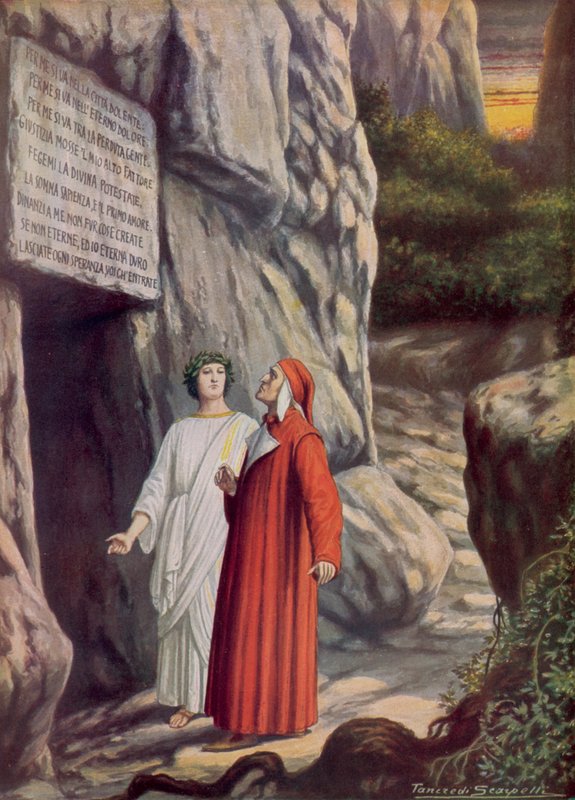
“ABANDON ALL HOPE YOU WHO ENTER HERE” (III. 9).1 Whether we have read Dante’s Inferno or not, we are all familiar with these words. When one wants to refer to the likeness of a place to Hell, this most famous excerpt from the inscription etched above its gate is quoted—thus even in jest, something of the universal despair of Hell is conveyed. But the Inferno is not a mere catalogue of tortures. For it is by these very punishments that the “DIVINE OMNIPOTENCE” (III. 5)2 also inscribed onto that ominous description that the “JUSTICE” of its “HIGH ARCHITECT” (III. 4),3 the Triune God, be better grasped.
The reader of the Inferno sees the misery of the damned; the astute reader of the Inferno sees the power of God triumphant in Hell. This power—omnipotence—shows itself magnificently with those other two divine attributes engraved beside it—”HIGHEST WISDOM” and “PRIMAL LOVE” (III. 6).4 This Trinitarian signature provides a clue to the reason why Hell is bereft of joy and full of pain: the damned have separated themselves, not from arbitrary divine whim, but from Power, Wisdom, and Love itself. They are punished according to their sins, and are therefore mired forever in the swamp of evil, the “defection of the created will” (Breviloquium III. 1),5 which, because it is rebellion against God’s ultimate power, can only be a pathetic, powerless darkness that flees before His brilliant Light.
When Dante is brought before the gate of Hell by Virgil, the “highest prince of poetry” (IV. 80),6 and his guide, the magnanimous Roman confronts the bewildered Florentine by holding his hand “with cheerful countenance” (III. 20),7 leading him into the dreadful abyss. Dante has been granted special permission to enter Hell as a living man, since the Blessed Virgin, St. Lucy, and Beatrice have taken pity on him, for he has “left the way of truth behind” (I. 12).8 It is Beatrice, the Poet’s childhood friend, who was sent to Hell to request Virgil’s help in rescuing the struggling Dante from the Wood of Error. Virgil is more noble than most of Hell’s denizens, given that he is placed within Limbo; Beatrice, “so lovely and blest a lady” (II. 53)9 addresses him with “an angel’s voice, / sweetly and softly” (II. 56-57)10—to whom the Roman master responds enthusiastically.
As Rome’s chief poet and one who seemingly anticipated the birth of Christ (cf. Eclogue IV), Virgil is uniquely positioned not only as Dante’s guide to Hell, but also as a symbol of Rome and Reason. For Virgil seemed to have come closer than any other Roman before Christ to belief in His coming, something which Dante reads into the Aeneid. Hence of Aeneas’ journey into the Underworld he tells Virgil:11
Upon this journey which you celebrate
he learned of things which were the cause of both
his triumph, and the mantle of the pope.
(II. 25-27)
Aeneas and Virgil are not only figures of Imperial Rome; they prefigure Catholic Rome. While Aeneas assumes a role akin to Abraham in this vision of history, Virgil assumes a role like to that of Daniel or another of the prophets. Such a view is not exclusive to Dante, for there had been others before him—such as St. Augustine—who rightly saw something providential in the ascendancy of Rome. However, it is Dante’s ability to interlink this idea with a series of others to form one harmonious whole through his art that makes his vision all the more compelling.
Virgil represents the last step before the fulfillment of Rome’s destiny as “the mantle of the pope.” It is fitting, then, that he also embodies the best of the classical world, especially in regard to its philosophical insights. Though these insights are of a dimmer light than the light of Faith, they are still a light: thus Virgil represents Reason. This is why he has recourse to the teachings of Aristotle in his explanation of the division of Hell; for as he reminds Dante:12
Don’t you remember your Philosopher—
the Ethics, where he treats at length the three
propensities that Heaven does not will,
Incontinence and malice and deranged
bestiality? And how incontinence
offends God less, is taxed with lesser blame?
(XI. 79-84)
The damned are therefore segregated into three main sections of Hell according to these categories of sin: incontinence, violence, and fraud. Thus, it will be worthwhile to respect this structure in this review by examining a sinner from each section.
Descending into the second circle of Hell, we are greeted by “a place where all light is struck dumb” (V. 28).13 The sinners here are thrown about endlessly by a “hellish cyclone” (V. 31);14 and “when they fall before the ruined slope” (V. 34),15 a slope that was wrecked by Christ when he harrowed Hell, “they hurl curses at the power of God” (V. 36).16 Here is the grim place where the full debt of lust is paid, a place where one is physically carried beyond one’s control in blinding darkness—a precise mirror of the spiritual effects of lust.
It is here that the poets and the reader meet the Italian noblewoman Francesca da Rimini and her adulterous lover Paolo, who is unremittingly bound to her. She, as many sinners will do in this poem, attempts to justify herself as she explains her story:17
Love that allows no loved one not to love,
seized me with such a strong delight in him
that, as you see, it will not leave me yet.
Love led us to one death. The realm of Cain
waits for the man who quenched our lives.
(V. 103-107)
We may indeed feel pity for Francesca’s fate (as Dante certainly does), but something rings false in her words; for as the believing Catholic knows, “God is charity” (1 John 4:16). There is nothing of Him here. St. James instructs us that “God is not a tempter of evils” (James 1:13), yet if we are to read Francesca’s “Love” as another name for God, she clearly states the opposite view. “Love,” according to her, “allows no loved one not to love.” Consequently, she tells Dante that “Love led us to one death,” thereby attributing all responsibility for her actions to “Love” and none to herself.
Though her intended meaning of Love is more likely the romantic idea espoused by the troubadours than a reference to God by means of one of His perfections, her claim grows no stronger because of this. Did St. Paul not write: “God is faithful, who will not suffer you to be tempted above that which you are able: but will make also with temptation issue, that you may be able to bear it” (1 Corinthians 10:13)? God will grant us His aid to flee from occasions of sin, but we must seek this light and act upon it. Francesca did neither. In her pride, however, she abdicates responsibility in the sweet name of Love—yet seems not only to have foreseen, but also actively desire the damnation of her murderer: “The realm of Cain / waits for the man who quenched our lives.”
How contrary is this attitude to the spirit of those animated by true Love! St. Maria Goretti prayed for the conversion of her murderer as she was being slain by him, and continued to pray for him in Heaven. Francesca, on the other hand, is now incapable of this real love: her love is false because she allowed lust to kill her soul before her murderer killed her.
Far, far below the circle of the lustful lies the seventh circle, wherein the violent against God are punished. Within this region those who “used force against the Deity” (XI. 46),18 the blasphemers, the sodomites, and the usurers, are confined to a desert where the only precipitation is an “eternal fire” (XIV. 37)19 that rains down, “sparking the sand like fuel beneath the flint, / doubling the sorrows of the damned” (XIV. 38-39).20 Dante stands upon a ridge overlooking this sorry, sterile plain when suddenly he senses a soul grab him by the hem of his tunic and quizzically exclaims, “What wonder’s this?” (XV. 24).21 Looking down, the Poet gives us this startling description of what follows:22
And I, when he’d stretched out his arm to me,
so fixed my eyes upon his crusted looks
that even the charred features could not keep
My intellect from recognizing them,
and lowering my hand toward his face
I answered, “Ser Brunetto, are you here?”
(XV. 25-30)
It is impossible for Dante to view Brunetto Latini, his former teacher, in anything but a personal manner; hence his apparent shock at seeing him here. Were we to embark on Dante’s journey through Hell, would not the sight of a beloved family member or fondly-remembered mentor produce a similar reaction from ourselves? Quite unlike a certain superficial impression of the Inferno suggests, this interaction reveals that its author wished to portray the divine justice not as a mere partisan to his own cause, but as the absolute, objective Justice—so much so that he placed a key mentor of his in this Canticle of Pain.
Since the acts of the sodomites pervert the procreative act against its end, the production of new human life, they do violence against God. Thus, as Virgil explains in a prior Canto, these sinners are among those who “scorn Nature and her generous goods” (XI. 48).23 In this they are like the usurers (who suffer a different punishment on this circle’s ledge), for they practice unnatural acts inversely: instead of rendering something life-giving sterile, the usurer makes mammon, which is lifeless, grow without labor as if it were living. But as St. Paul warns, “God is not mocked” (Galatians 6:7). The sodomites’ sterility in life is rewarded with an eternal, aimless sterility—they wander in bands ceaselessly in a wasteland. Just as their use of sexuality cultivated no fruit, they will be forever surrounded by fruitlessness. The flames that fall upon them must burn; yet this pain only singes in comparison to that torrent of fire which rages in their conscience for having rebelled against the Author of Life’s command to increase and multiply (cf. Genesis 1:28).
The poets proceed to the edge of the seventh circle; they take a ride on the back of Geryon, the monster of fraud “whose stench sickens the world!” (XVII. 3).24 They land in Malebolge (“evil ditches”), a foul place within which the fraudulent are entrapped, though treachery, the sum of fraud, is punished even lower. Coming then to the third ditch of the eighth circle, Dante sees a multitude of holes carved into the walls and the “livid iron stone” (XIX. 13)25 of the barren canyon. Out of each hole a pair of human feet flail about in agony, and as the Poet relates, even “the soles were set afire” (XIX. 25).26 For these holes are the final dens of the simonaics, who once bought and sold church offices because of their love for money, which is as St. Paul writes is “the root of all evils” (1 Timothy 6:10).
Among these satanic baptisteries he finds the one wherein the soul of Pope Nicholas III lies. Despite Dante’s stated “reverence for those highest keys” (XIX. 101)27 that this sinner previously held in life, the Poet’s respect for the papacy does make him withhold his denunciation of this profligate—though he does admit that he would “use words heavier than these” (XIX. 103)28 had he not this reverence. The oratorical assault that Dante unleashes is therefore an act of righteous anger: in a similar manner to Christ driving the money-changers from the Temple, it is measured and powerful, devoid of any unreasonable emotive outbursts. Speaking of Pope Nicholas and others who follow him in this sin, he says:29
About you shepherds was the prophecy
of the Evangelist, when he saw her
who sits upon the seas, whoring with kings:
The woman who was born with seven heads,
who from ten horns, the Ten Commandments, took
her strength, so long as virtue pleased her spouse.
(XIX. 106-111)
Through this symbolic interpretation of the Whore of Babylon, the Poet articulates the idea that the Church has been defiled by the simonaics. In doing so, she has become a partner to Babylon, which must be some worldly power, or perhaps the world itself. The Church is this seven-headed woman, for she possesses seven sacraments, and she “took her strength” from “ten horns, the Ten Commandments”. But Dante tells us that she has lost something of her strength; for she “took her strength” from the Ten Commandments “so long as virtue pleased her spouse.” This spouse is the pope, who is married to the Church as the Vicar of Christ. Therefore, the simonaic popes became displeased by virtue, and in union with the other simonaic clergy, have falsely wedded their lust for gold to the sanctuary.
To compare, then, the state of the Church in his times to the Whore of Babylon was a choice of Dante’s genius. As he opens this Canto with a searing rebuke of the simonaics who follow the accursed Simon Magus in buying and selling “the things of God” (XIX. 2),30 which should be “espoused to righteousness and love” (XIX. 3),31 so too can the prostitute be rebuked on similar grounds. What is a whore in the old sense of the term? A woman who sells her body, which ought to be a “temple of the Holy Ghost” (1 Corinthians 6:19), and engages in acts that are either unnatural (and thus immoral in themselves) or should be “espoused to righteousness and love” for they belong to the married. The simonaic clergy, then, whored out the Church, the Bride of Christ, in an analogous manner to how prostitutes whore out their bodies.
All this should sound eerily familiar to traditional Catholics—as it ought to. Our case, admittedly, is more dire. Though the simonaics attempted to whore out the Church by marrying mammon to her, they never attempted to change her doctrine. The same cannot be said of the modernists. They have not only attempted to whore out the Church to mammon; they have brazenly attempted to marry heresy to the Bride of Christ. Mirroring how the simonaic occupation of the Church was led by profligate popes, the post-Vatican II papal claimants and their present successor have been leading a modernist occupation of the Church for over the past sixty years.
They have engaged in “whoring with kings” by bowing before a modern world that seeks to trample and spit upon everything sacred. Have they not “sold out” White Catholics in their unabashed support of the United Nations and its replacement migration policies? Have they not “sold out” the Catholics who live under Muslim and Communist tyrants by promoting “dialogue” with their regimes? And these examples, which are evident to all reasonable persons, are only two among hundreds (if not thousands) that could be cited. It can be justly maintained, therefore, that this metaphor can be used by ourselves. We, like Dante, must preserve our faith in the spiritual purity of the Church that outlasts, and will outlast, the damage wrought by perverse clergy upon the temporal institution.
It is evident that the Inferno has much to say to us today. Though it is true that all the genuine classics have an immortality to them, it is the Inferno and its two sequels which best embody this reality. For the Divine Comedy is, at its essence, a spiritual journey; man is endowed with an immortal soul and thus an eternal destiny. It is this epic above all others which speaks best to that destiny.
No poet before or since has painted so profound a matter in such brilliant words, which glimmer even through the medium of translation. The Inferno teaches us that while there is indeed a realm of everlasting torment, the means of avoiding it are surely within our reach. The figure of Dante, or the Pilgrim, represents the soul who has strayed from the Faith, but has been offered a chance—a mercy—from Heaven to return back to “the way of truth” (I. 12) before it is too late. We, unlike Virgil but like Dante, are fortunate to live in the Christian era; Christ has risen and founded His Catholic Church, which despite the sins of her clergy and laity, remains the pure stream through which grace flows into this valley of tears. What fools are we if we do not cooperate with this grace! Dante shows us through his sinners the underlying ugliness of sin that hides itself so easily in this life, but will be entirely unmasked in the next. Woe to us if we, like the sinners of the Inferno, die in the very vices that shall torture us forever!
On the subject of translation, there are many translations of Dante: this reviewer has only read Esolen and Ciardi’s translations in their entirety, and Longfellow and Musa’s translations in part. They are all recommended. However, Esolen is to be preferred above the others on account of his superior notes and commentary, which complements his balanced translation. Moreover, the presence of the front-facing Italian original text in this Modern Library edition, alongside appendices and some of Doré’s illustrations, are added bonuses. However, it lacks the maps and schemas present in Ciardi’s New American Library edition, which are a very useful aid.
Take the first foray into the Divine Comedy. Dante was neither a prophet nor a doctor of the Church; he made errors, but his sensus Catholicus was basically sound. Pick your translator and read the Inferno for yourself: witness therein the ultimate triumph of Good even in the darkest pit of the universe.
-
Alighieri, Dante. Inferno. Translated by Esolen. Modern Library Classics. Mass Market Paperback edition. 2005. p. 23.
-
Ibid.
-
Ibid.
-
Ibid.
-
St. Bonaventure. The Works of Bonaventure: Cardinal, Seraphic Doctor and Saint, Vol. II: The Breviloquium. Translated by José de Vinck. St. Anthony’s Guild Press. 1963. p. 110 (pt. iii, ch. 1).
-
Alighieri, Dante. Inferno. Translated by Esolen. Modern Library Classics. Mass Market Paperback edition. 2005. p. 37.
-
Ibid.
-
Ibid. p. 3.
-
Ibid. p. 17.
-
Ibid.
-
Ibid. p. 15.
-
Ibid. p. 113.
-
Ibid. p. 47.
-
Ibid.
-
Ibid.
-
Ibid.
-
Ibid. p. 51.
-
Ibid. p. 111.
-
Ibid. p. 141.
-
Ibid.
-
Ibid. p. 153.
-
Ibid.
-
Ibid. p. 111.
-
Ibid. p. 171.
-
Ibid. p. 191.
-
Ibid. p. 195.
-
Ibid. p. 199.
-
Ibid.
-
Ibid.
-
Ibid. p. 191.
-
Ibid.