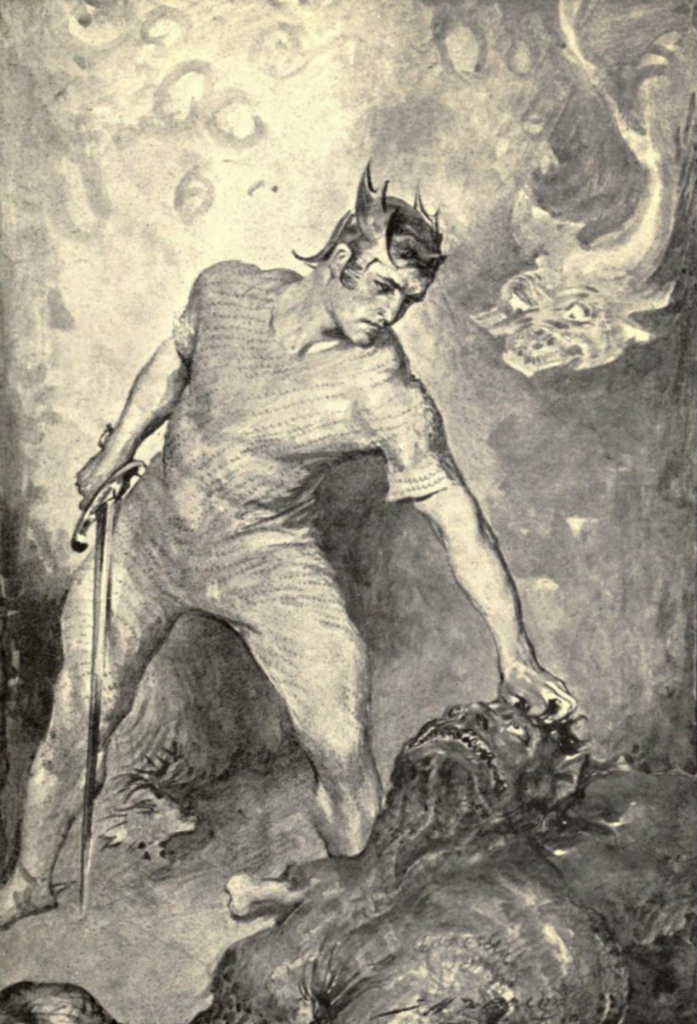
![Beowulf decapitates Grendel, illustration by J.H.F Bacon from Hero-myths & legends of the British race, Maud Isabel Ebbutt, [1910?].](https://commons.wikimedia.org/wiki/File:Hero-myths_and_legends_of_the_British_race_(1910)_Beowulf_decapitates_Grendel.png?uselang=en-gb)
Available from Amazon, Thriftbooks, Abebooks
Book Length: 256 pages
Beowulf is indeed an English epic, though not one Englishman appears in its events. For it is a tale that was built upon preceding Germanic tales which were brought into England by the Scandinavians during their Dark Age incursions. Thus the Geats, Danes, and Swedes figure in this poem, but not the Anglo-Saxon; yet its anonymous composer, quite likely an English Catholic monk, saw the relevance of the tales of these Northern Europeans to his own folk. And as the Scandinavians who settled on the Isle soon converted to the Faith, so too did this author Christianize his story while drawing upon pagan traditions. It is in this context that the alliance between Hrothgar the Dane and Beowulf the Geat against the monstrous can be truly appreciated.
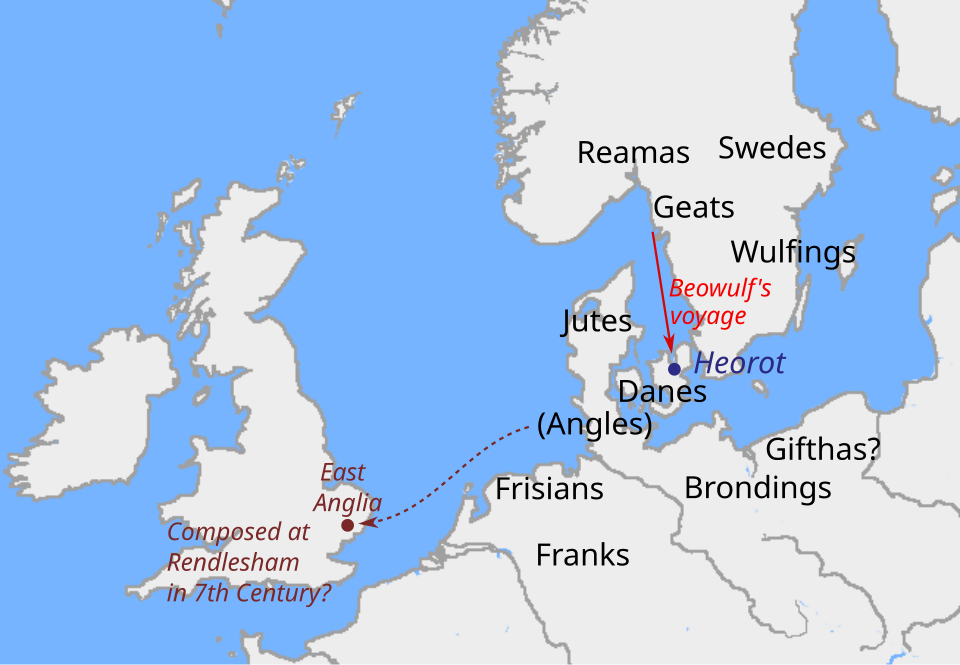
The tribes of the Beowulf story. Image courtesy of Wikimedia Commons.

The pagan societies of the Dark Ages were, as Seamus Heaney describes them in the Introduction to his translation, “at once honour-bound and blood-stained” for they were bound by “the laws of the blood-feud” (xiii),1 which mandated the revenge either in blood or in money. Such a state of affairs is reflected in the saga of Finn and his sons, a story within a story: it is sung by a bard during a feast to commemorate Beowulf’s vanquishing of the monster Grendel. This is a detail not without significance, as shall soon be discussed.
This saga relates a conflict between a party of Danes and a party of Frisians. After a costly battle between both sides which sees the Danish lord Hnaef among the slain, the surviving Danes are subjugated by the Frisians, and thus are compelled to serve Finn, their lord. It is an arrangement that does not last, for it proves to be an intolerable one for the Danes. Voicing the restless spirit of Hengest, the successor to Hnaef, the bard declaims:2
(Beowulf. 1135-1144)Then winter was gone, earth’s lap grew lovely, longing woke in the cooped-up exile for a voyage home— but more for vengeance, some way of bringing things to a head: his sword armed hankered to greet the Jutes.
The blood-feud weighs upon him and his men; thus they slaughter Finn and the Frisians to collect their debt. In their frenzy, the Danes forget not to take Finn’s wife Hildeburh back with them to Denmark. It is she who is the most pitiful figure in this tale, for she is trapped between both parties: a Danish princess who by the saga’s end is left lamenting the loss of her brother Hnaef and her husband Finn, and her sons begotten by the Frisian lord.
The vengeful spirit that animates the practice of the blood-feud is given a more exact physical incarnation by the Beowulf poet through the characters of Grendel and his mother. As with the innocent Hildeburh, she mourns a son slain; unlike the princess, Grendel’s mother is not innocent and chooses to partake in her own version of the blood-feud. For Grendel’s mother, as Grendel himself is described, is “the Lord’s outcast” (Beowulf. 169),3 as both are monstrous descendants of Cain. Their seemingly half-human and half-bestial appearance mirrors the subhumanity of fratricide, the crime of Cain. In the appearance and actions of this inhuman family the Beowulf poet illustrates the true nature of the blood-feud: a “culture” of slaying racial kin and brothers that does not restore balance, but only lays the seeds of future bloodshed.
Shunning even the company of a warband, Grendel initiates an unprovoked “lonely war” (Beowulf. 164)4 against the Danish great hall of Heorot. Unlike the Germanic peoples of this poem, Grendel fights and kills alone—just as Cain was sentenced by God to wander the earth alone after slaying his brother Abel. Both Cain and Grendel typify what fratricide is, and so both must reject the society of their fellow men because fratricide is a crime not only against the divine order and the individual, but also against society itself. Without trust, there can be no loyalty. Hence, if one cannot even trust one’s natural brother, then how can one be loyal to a society of martial brothers? Grendel therefore wages his war alone because he, as a son of Cain, trusts no one and cannot be trusted by others.
But as even evil mothers can show love for their children, so too does Grendel’s mother show a certain loyalty to his memory. After Beowulf and the Danes celebrate the former’s victory over the fallen Grendel, the Beowulf poet introduces the reader to his mother: she is “grief-stricken and ravenous” and “desperate for revenge” (Beowulf. 1278).5 This is quite similar to the attitude of Hengest and his Danes in the saga of Finn and his sons who longed for “vengeance” and, as it will be remembered, “some way of bringing / things to a head” (Beowulf. 1140-1142).6 Though the Danes evidently were not monsters in that tale, their actions are thereby linked to the monstrous.
By subtly interlocking the rampage of Grendel and his mother and the terrible events of the saga of Finn and his sons, the unknown author of Beowulf unmasks the anti-social destruction that wore the face of honor among the Germanic peoples that practiced the blood-feud. However, the poet did not merely write this work to condemn that false code of honor; he also endeavored to show how a true code of honor could arise. It is the Danish King Hrothgar and the eponymous Geatish hero of the story, Beowulf, who each in their own ways demonstrate a form of leadership that rejects the racial fratricide of the blood-feud.
During his initial meeting with the youthful Beowulf, the aged King Hrothgar tells him of a feud that arose between Beowulf’s father and King of the Geats, Ecgtheow, and the Wulfings, another Germanic people. The King chose not to resolve the conflict by force; instead, as he remarks, “I healed the debt by paying” (Beowulf. 470).7 He thus paid the price of the feud with the wergild (“man-price”),8 instead of having it paid in blood.
In the grand chain of events, this decision led to Beowulf arriving at Heorot to help the Danes in their hour of need, just as King Hrothgar had helped King Ecgtheow in his. By choosing a peaceful means of ending that prior conflict, it is fitting that Providence sent Beowulf to fight against Grendel, the new Cain, with “complete trust / in his strength of limb and the Lord’s favour” (Beowulf. 669-670).9 For as Christ said: “Blessed are the peacemakers: for they are the children of God” (Mark 5:9). And in Beowulf’s coming, there is a great blessing indeed.
While King Hrothgar’s example illustrates that it is better to resolve conflicts without bloodshed, Beowulf’s example shows that there are inplacable enemies who must be fought. The epic’s narrative never doubts that destroying Grendel and his mother is the right response to their raids on Heorot: they are monstrous outcasts, and monsters cannot be reasoned with. As they embody the spirit of the blood-feud, they must be as irrational as that law of retribution’s worst manifestations. Beowulf must oppose these manifestations of evil with violence—still more, he must do with this with a higher ideal than that of brutish revenge.
It is his desire to obtain “the privilege of purifying Heorot” (Beowulf. 431)10 that encapsulates this higher ideal: in offering his life to defend a tribe not his own, though kindred to it, he exhibits a generous giving of self. He, like the true Christian warrior, may well pray: “Blessed be the Lord my God, who teacheth my hands to fight, and my fingers to war.” (Psalms 143:1). For he fights not only for his own mere glory, but also because he loves his neighbor.
This Christ-like heroism informs King Hrothgar’s final speech to Beowulf, before the Geat returns to his homeland. Among his praises and admonitions, the King tells the young warrior:11
Choose, dear Beowulf, the better part,
eternal rewards. Do not give way to pride.
(Beowulf. 1759-1760)
For though Beowulf is a virtuous man, King Hrothgar possesses the wisdom of paternal experience, and thus has an eye for that most common corrupter of heroes: pride. The King tells him therefore to seek “the better part, / eternal rewards”, for man’s fulfillment cannot be found in this world. In the end, true glory is not to be sought in battles or treasure; rather, humility is the one thing necessary. Humility in the face of one’s achievements is necessary to possess transcendent glory, the reward of Heaven, of which earthly glory is but a mere shadow. Beowulf takes this advice to heart. He succeeds the throne of his father, and like Hrothgar, notably rules for a period of fifty years12 before he is challenged by a monster that threatens his own dominion. Fittingly, the monster he faces as an aged king is a treasure-hoarding dragon, a beast that lusts after gold and blood—the antithesis of the warrior that Beowulf was, and the ruler that he becomes.
At its foundation, Beowulf is a bridge between the English and the Germanic peoples; it is more than this, however, for it also stands as a bridge upon which any man of Europe or her diaspora can cross. Today the men of the West are faced by monsters literal and allegorical that, in like manner to the monsters of this epic, seek to eradicate our peoples and our civilization. We therefore ought to embark upon this journey and learn from it. Let us learn from Hrothgar and Beowulf how to make peace with our brothers and wage war against evil. May each of us, imitating that Geatish hero, place “complete trust / in his strength of limb and the Lord’s favour” as we face the world, the flesh, and the Devil in our own epic struggle for the salvation of the West.