
Available from Abebooks and Amazon
Book Length: 355 pages
Our world is rife with corruption; our Church is rife with scandal. Yet Catholics are called to be in this world and not of it. How can this be so in these times? To this question, the distant voice of the English poet William Langland cries out to us as a “voice of one crying in the desert” (Matthew 3:3)—the desert of our medieval past. For the series of allegorical visions that Langland presents in his poem Piers Plowman are admirable depictions of the pursuit of holiness in a fallen world. Taken together, these visions form an all-encompassing quest for the true spiritual life—one that was not meant for his age alone, but ours as well.
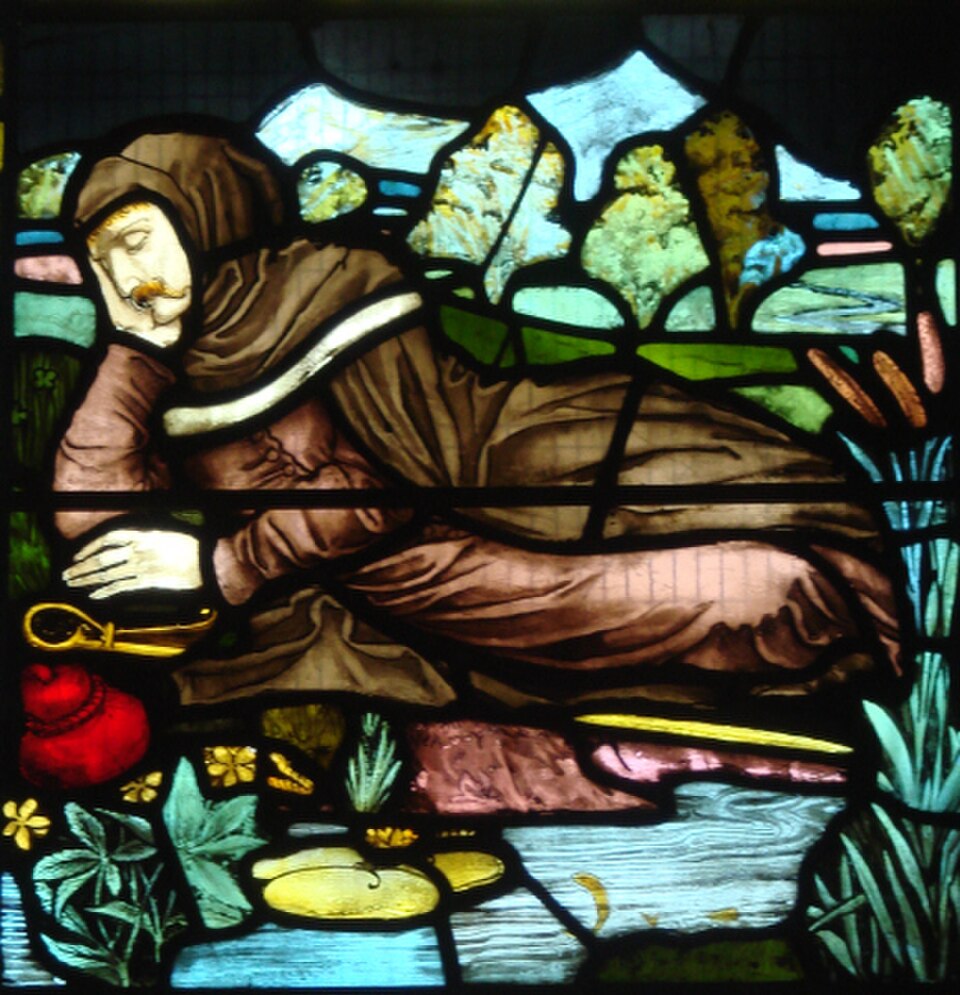
The story begins with the protagonist, Will, falling asleep and experiencing a dream in which he sees “a beautiful field filled with all kinds of people” (1).1 Such a detail establishes an important precedent for the rest of this work: its intimate concern is not merely the salvation of one soul, but the sanctification of social life alongside the pursuit of holiness on the individual level. After the Prologue, within which Langland presents the reader with a vivid description of the virtuous and vicious in all ranks of English society, Will is introduced to “a lady with a beautiful face, clothed in a linen dress” (8) who reveals herself to be Holy Church.
Her role is to provide Will with initial guidance and motivation before he receives further visions that will aid him in his newfound desire to live the true spiritual life. (Incidentally, this plot point echoes the interaction between the analogous figures of Lady Church and the protagonist of the antique The Shepherd of Hermas). Part of Holy Church’s instruction to Will is her explanation of Truth and Love to him:
(12)
Truth is a kind of instinctive understanding located in the very depths of your heart. It teaches you to love the Lord your God more than your very self, and never to commit a mortal sin, even at the cost of your own life.
Truth is defined by Holy Church as the sensus fidelium on the part of the believer: it is a “kind of instinctive understanding” informed by the Faith, which transcends mere human reason. Hence it encourages the soul to “love the Lord God more than your very self”—for there can be no genuine conflict between Truth and Divine Revelation. Her explanation of Love is also touching. Using an analogy that would have been more readily understood in Langland’s age, she says:
(13)
Love is a mediator…like a mayor between the king and the common people.
Love, then, has an intercessory nature. It is meant to connect, not to rupture; to give, not to take. Intertwined with this point is the Christological connotation that comes with the term “mediator”. Jesus Christ, fully God—and since He is God, He is also Love itself (cf. 1 John 4:8)2 —and fully man, mediates for us before His Father in a similar manner to Holy Church’s example of the mayor mediating for the “common people” before the king. The idea of love as mediation is further explored in the poem through its titular character, Piers Plowman.
Will first sees Piers Plowman during a vision within which he witnesses a “myriad of people” who earnestly implore “Christ and his Virgin Mother, asking for grace to go and search for Truth” (59). Piers knows where to find Truth; he declares that he has been “his follower for the last forty years, sowing his seed and tending his stock” (60). Allegorically, his decades-long laboring under Truth represents his depth of soul. He is a true veteran of the spiritual life, at the very least.
Thus, Piers is capable of directing these pilgrims on this allegorical pilgrimage to Truth—and not only capable, but willing, for he is a man of good will. Describing Truth, he says:
(Ibid)
He’s as meek as a lamb and the words he utters are kind. If you want to know where he lives, I’m more than willing to show you the way.
The language that Piers uses here clearly indicates that Truth is simply Christ by another name: “meek as a lamb” evidently recalls what Our Lord said of Himself: “Take up my yoke upon you, and learn of me, because I am meek, and humble of heart: and you shall find rest to your souls” (Matthew 11:29). By offering to help this crowd find Christ, it is Christ who works through Piers to direct these souls to Himself. Piers therefore takes on the role of a mediator—he is like the mayor that Holy Church describes, for he stands like a priest between these common folk and Christ the King.
But it is not only this crowd who are drawn to Piers: Will finds himself drawn to this holy man as well. Consequently, Will takes the path delineated by Piers, a long arduous adventure wherein he meets all sorts of allegorical figures who either aid or challenge him in his spiritual quest.
Eventually in this pilgrimage, Will encounters a figure named Anima, who represents the soul. During their conversation, Will asks Anima where Charity can be found, since he has struggled to find him on his own. After Anima describes some of Charity’s good works and benevolent nature, Will remarks:
(173)
‘Ah Christ!’ I exclaimed, ‘I wish I knew the man! There’s no one in the world I’d rather know!’
Which then invites this further dialogue between Anima and himself:
‘But you will never see him in person’, he replied, ‘without the help of Piers Plowman.’
‘But the clergy who look after the Church,’ I returned, ‘do they know him?’
‘The clergy?’ he said, ‘they too have no knowledge of him—except through actions and words. But Piers Plowman has deeper insight into the heart of a man’s intention, and into the reasons why men suffer: “And God saw their thoughts…”
(Ibid)
Thus Anima conveys that Piers Plowman—the holy farmer who symbolizes, as Dawson observed in his analysis of this book, “the threefold state of humanity”3—shall serve as Will’s intermediary between Will and Charity. By this, Langland is likely indicating that the will (as in the faculty of the soul) requires more than “actions and words” to unite with the virtue of charity: a “deeper insight” is necessary, an insight that the clergy generally lack because they are found wanting in holiness.
For it is holiness of life that grants one the “deeper insight” which Piers Plowman possesses—and indeed, one can find this “deeper insight” in the saints. After Christ, who understood “the heart of a man’s intention, and the reasons why men suffer” better than the Blessed Virgin Mary? She kept the mysteries of the Child Jesus “in her heart” (cf. Luke 2:19; Luke 2:51); and where most of the disciples fled at the foot of the Cross, she stood firm, witnessing and participating in the mystery of Calvary as she bore her Son’s pains in her heart.
This “deeper insight” is also found with the saints of the lower orders of Paradise. Where Freud and Jung struggled in their Kabbalistic-Gnostic pretenses to understand “the heart of a man’s intention, and the reasons why men suffer”, St. Paul and St. Augustine delivered luminous clarity. The stigmatist saints such as St. Gemma Galgani and Padre Pio likewise revealed a profound understanding of these matters, not in spite of, but because they bore the wounds of Jesus on their bodies. It is then neither to the worldly nor to the learned we should turn to for answers to the problems of the heart and the soul—it is to the holy.
Following from his answer to Will’s question about the clergy, Anima tells Will:
(174)
So, you can never recognize Charity through his outward appearance or his air of learning; not even through his words or actions, but only through the will. And what that is, no living creature knows—save Piers Plowman, “Peter, that is Christ”.
It is “only through the will” that Charity can be recognized, for Charity belongs to those of good will. Did not the angels announce to the shepherds on the night of the first Christmas: “Glory to God in the highest; and on earth peace to men of good will” (Luke 2:14)? St. Peter received the keys of his office from Jesus because he confessed to Him: “Thou art Christ, the Son of the Living God” (Matthew 16:16). This confession of his belief in Our Lord’s divinity was neither the result of logical deduction nor emotional enthusiasm. It was St. Peter’s response to the gift of faith. Hence why Our Lord told him: “Blessed art thou, Simon Bar-Jona: because flesh and blood hath not revealed it to thee, but my Father who is in heaven” (Matthew 16:17). Those who are animated by good will humbly accept God’s Will; those who are dominated by their flesh and blood are too proud to do so. Holiness therefore neither consists in “outward appearance or air of learning” nor “actions or words”: it consists in something internal, which is good will—a term easily abused in our time.
Good will is not something that springs up from emotion; it positively responds to the gift of grace. Thus the reader is led back to the lessons that Holy Church gave to Will about Truth and Love. For the sensus fidelium of Truth and the mediating power of Love must reside in a soul in order for good will to be present there. But something so interior cannot readily be perceived. Hence Anima states that of this “no creature knows—save Piers Plowman” since his holiness has rendered him an alter Christus. It is in the figure of Piers Plowman that Langland finds the key to the Catholic life: a holy laborer, for as Dawson commented, “Christianity is the labour of love”;4 Piers produces good works because he is a man of good will.
In closing, this medieval masterpiece is surely worth revisiting, and is surely to be recommended for the Catholic student of literature. The Oxford World’s Classics edition is particularly advised for reading, for its rendition of the original Middle English text into modern English and its lengthy notes section. The translation has been done respectfully, and has broadened the accessibility of Piers Plowman to the average person, to whom Middle English practically reads as another language. Complementing this is the notes section located after the text, which thankfully does not attempt to editorialize or reinterpret the Catholic content of this book. Instead, what the translator has provided is a helpful commentary.
The portrait that Piers Plowman offers has much to teach us about Langland’s time and ours, especially when it is considered that the author lived through the Great Western Schism, the Crisis of the Church of his age. He did not despair in the midst of such a scandal. On the contrary, his poem reveals him as a man who bewailed the failures of the clergy and layfolk alike while never losing faith in the teachings that they were called to uphold. He saw the key to restoring Christendom in the multifaceted figure of Piers Plowman—the holy man of simple life who, on account of good will, truly becomes a mirror of Christ.
Rightly could these words of St. Paul be applied to Piers: “And I live, now not I; but Christ liveth in me” (Galatians 2:20). Let his character be an encouraging lesson to us to respond to the gift of grace at every opportunity and to participate in the life of Christ through prayer, the sacraments, and the Holy Mass. May we, like Piers Plowman, labor under the guidance of Holy Mother Church for the salvation of souls and for a Christendom reborn!
-
All quotations of this text are provided from:
Langland, William. Piers Plowman: A New Translation of the B-Text. Translated by A. V. C. Schmidt. Oxford World’s Classics. 2009.
-
“He that loveth not, knoweth not God: for God is charity.”
– 1 John 4:8
-
“First he appears as man, the child of nature, the peasant who sustains the world by his labour. Secondly, he is the Son of Man and the Son of God who saves the world by his blood…thirdly he is the figure of the Church, the new spiritual humanity, anointed and enlightened by the Holy Ghost to carry on the work of unity and salvation.”
Dawson, Christopher. Religion and the Rise of Western Culture. Image Books. 1991. pp. 222-223.
-
Ibid. p. 223.