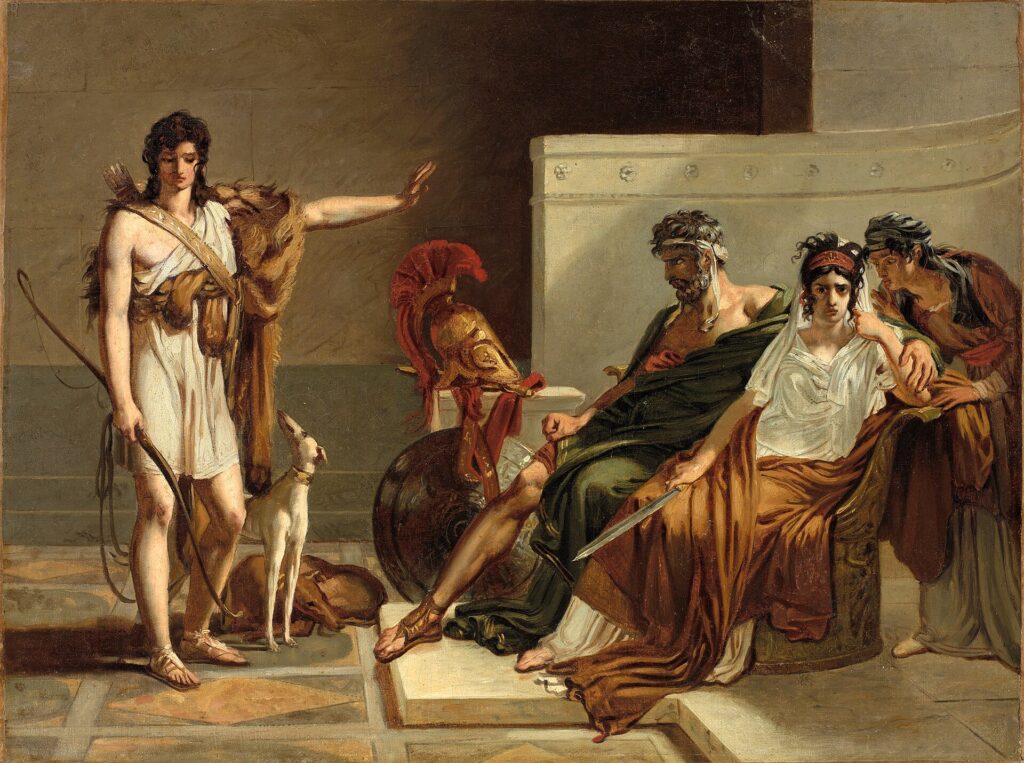
Phaedra and Hippolytus by Pierre-Narcisse Guérin

Available from Amazon and Thriftbooks
Book Length: 192 pages
The battle between one’s reason and one’s passions occasions some more than others, but it has been experienced by practically everyone. Internal flames flare when we are around certain persons or in certain places and threaten the loss of “the good of intellect” (Inferno III. 18)1 if they are not put out. But what is the water for this fire? It is the Cross. For in offering our suffering in union with Christ, we can find solace in Him who bore our infirmities while remaining perfectly innocent. Without this recourse, however, we can find little in our mere fallen nature to resist this fire—and this is what the brilliant French playwright Jean Racine illustrated centuries ago in his Phèdre.
As he himself writes in the Preface, in this play “passions are represented only to show all the disorder they occasion” (23).2 Though it is true that his association with the Jansenists may have made him overrate the power of the passions, the fatalism in this work is the fatalism that was latent within Ancient Greek paganism. If Racine’s theme of the helplessness of man against himself is Jansenist, it is also pagan. For his retelling of the Phaedra myth highlights the inability of paganism to confront the passions and, prior to this, its dim understanding of divinity. Such a lesson is certainly not outside of the boundaries of the Church. In the juxtaposition of the powerlessness experienced by the play’s characters over their passions to the freedom that is offered to us through the sacraments, one finds what is perhaps this work’s most profound lesson.
The pagan fatalism towards the passions and divinity is most exemplified in the characters’ references towards and appeals to Venus, the goddess of Love. When speaking to Hippolytus, the son of Theseus, during the first scene of the play, his teacher Theramenes remarks, “What heart has ever been too brave to be / Vanquished by Venus?” (I.i.).3 It is taken for granted that this goddess triumphs over the hearts of mortals. None can truly resist her influence, even royalty; in time, she wears down all those who scorn her, as Hippolytus tries to do. This, of course, extends beyond a theological claim—it can be taken symbolically to represent the powerlessness of fallen man over this passion. In this pagan cultural context, this passion is divinized, perhaps explaining the seemingly otherwise inexplicable effects of sensuality by attributing it to a higher power, thus a being that can easily overpower man’s best efforts to resist it.
The character who undergoes the fiercest battle against Venus is Phaedra herself, the titular character of the play. Her various monologues expressing her inner turbulence as her sexual desire combats her will are this work’s most marvelously agonizing moments. They strike the observer with pity and disgust simultaneously. For one gathers that she feels the loss of her reason, but seems also to participate in it, though at the behest of forces more powerful than herself. Thus as Racine comments, she is “neither entirely guilty nor entirely innocent” (19). Phaedra occasionally breaks out into declarations that, if carefully read, bear out her author’s intention—such as this declaration to her servant, Œnone:4
Where, where have I let stray
My longings, and my self-control? Œnone!
The Gods deprive me of the use of it.
(I. iii.)
Here the Cretan queen has stated both her powerlessness over and her participation in her illicit desire. She says: “where have I let stray / My longings and my self-control?”—and here she betrays her partial guilt. Phaedra’s use of “I”, indicates the involvement of her own will; she has not said “where have they let stray”, which would place all culpability on the gods. But then this is shortly followed by her asserting that the gods have deprived her of “the use” of her self-control, thus pivoting responsibility to these divinities. Her sensual desire is spurred on, and she spurs herself further into it.
That she does not fully cooperate in this desire is borne out by these striking words, which shortly follow that of the previous declaration:5
Against my will my eyes
Fill up with tears.
(I. iii.)
Phaedra is powerless enough to hate the tears she is shedding for him she knows she cannot have. She understands the guilt that accompanies her desire and tries to fight it. But much like her tears, she cannot keep her passionate feelings in check.
Towards the latter part of Act I, she announces that she can no longer contain this passion within her; she feels that she must yield to it. For Phaedra says:6
No longer is it the fever of the blood
Concealed within my veins, but She, herself,
Venus herself, entire, crouched on her prey.
(I. iii.)
Venus then has not only cornered her, but she has conquered her as well. The “fever of the blood” represents the sickness she has undergone as a result of this passion; it is no longer “[c]oncealed within” her “veins” because Phaedra recognizes that the open admission of her passion to Œnone has only inflamed it. Thus the queen’s confession enables the escalation of her desire—she ends more feverish, not less.
Racine’s tragedy offers a foil in its presentation of the seemingly unbeatable force of passion—divinized as Venus—to the theological virtue of caritas (charity), authentic love. For caritas, unlike Venus, does not crouch “on her prey”; charity does not take, she gives. This giving occurs through the communication of good both spiritual and physical. For charity is manifested through acts and words in fulfillment of the Commandments and oriented towards the well-being of ourselves and our neighbors, and all this in cooperation with the grace of God, who is Love Itself.
While the pagan belief system within the world of Phèdre does offer a vision of virtue, it is one in which caritas does not exist, for within the Greek mythology the gods were themselves no exemplars of virtue and furthermore were often the source of temptation among men. Such is the case with Phaedra herself, who is cursed by the gods and haunted by Venus in particular. With no higher power to appeal to for chastity—as even the goddess of love was herself the cause of impurity—all that Phaedra can do is to fight her desire with the best of her willpower. But as the progress of the plot within Act I indicates, this is not enough. Even her attempt to unburden herself of these smoldering feelings by revealing them ends in her further surrender to them. The message then is clear: in this world, man stands helpless before forces—whether of his own flesh or of divinity—that far outmatch his capacity to resist them.
In the Catholic system, this is entirely different. Man is indeed not the absolute power in the universe, but he stands with far more agency—though he suffers from the consequences of Original Sin—for he has received aid from His Creator, Who has also freely condescended to become His Redeemer. There are no multiplicity of gods fighting against one another; there was only one war in Heaven, and this resulted in the banishment of Satan and his wretches from the face of the Triune God. It is this God who was not only content to defeat evil in Heaven, but also in the world, by sending Jesus Christ to sacrifice Himself upon the Cross to redeem mankind. But Christ did not leave us orphans; He founded the Church to perpetuate His work.
Among her treasury of sacraments given to her by Christ, one finds the sacrament of Penance. Here there is no confession to a mere servant, but a man who is a consecrated servant of God; one who is bound to keep the penitent’s secrets, and possesses what St. Bonaventure terms “the power of the keys”7 to loose him from his sins. In the confessional, the passions are named honestly—and to one through whom Christ counsels and absolves, offering grace sufficient to conquer the afflictions of the soul. While Jansenism’s excessive rigorism downplayed the power of this sacrament, it remains that its role within the Catholic system is a rebuke to the blindness of pagan Antiquity. As a result of the Incarnation, there has been a genuine enlightenment—one of grace that can be accessed by all men under the aegis of a benevolent God. Racine’s adaptation of this classical tragedy thus brings out the contrast between the world before Christ and the world after His Coming.
This then is a work to be recommended to the sincere student of literature and culture. In it, one finds that the error of exalting sensual desire is not a new problem—it is in fact one older than even the Church. Yet, the solution to the chains of Venus remain: the power of the keys offered to us in the confessional by the priests of Christ. We can be freed from Venus; it remains to us, however, to make that choice—to confront our passions in the confessional where grace is abundantly offered us, rather than abandoning ourselves to the doom of fatalism.
-
Alighieri, Dante. The Inferno. Translated by John Ciardi. The Divine Comedy. New American Library. 2003. p. 31.
-
All quotations of this text are provided from:
Racine, Jean. Phèdre: Édition bilingue. Translated by Margaret Rawlings. Penguin Classics. 1991.
-
Ibid. p. 35.
-
Ibid. p. 41.
-
Ibid.
-
Ibid. p. 53.
-
St. Bonaventure. The Works of Bonaventure: Cardinal, Seraphic Doctor and Saint, Vol. II: The Breviloquium. Translated by José de Vinck. St. Anthony’s Guild Press. 1963. p. 257 (pt. vi, ch. 10).