
Available from Irvingbooks.com and Abebooks
Book Length: 573 pages
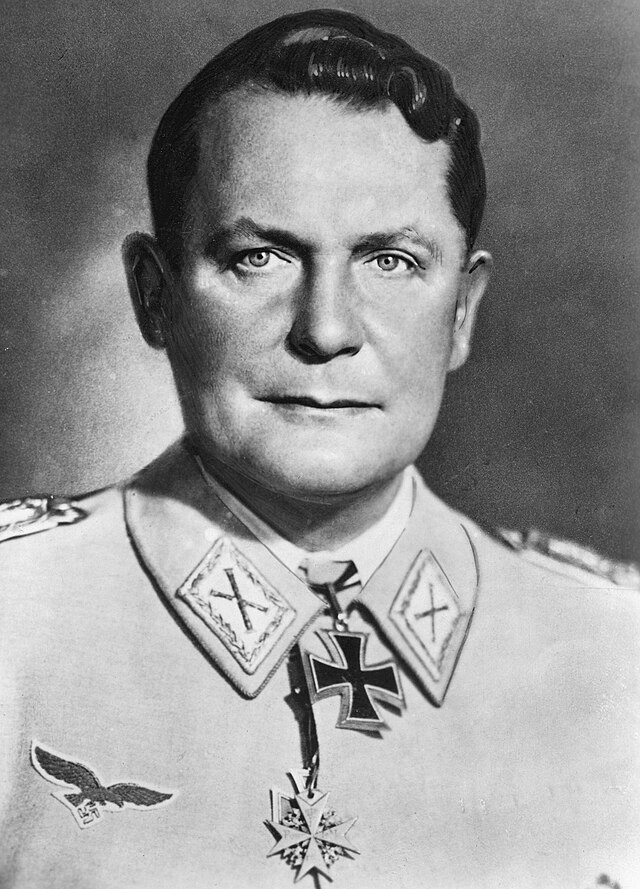
It is an easy thing to mock the vanquished – especially so fine a target as Hermann Göring appears to present. That he was a loyalist to the NSDAP to the very end makes him already “fair game” for opprobrium in the eyes of many; his infamously extravagant lifestyle invites ridicule. David Irving paints a different portrait in this biography: a soldier eager for fame who became corrupted by it—yet never to the point of the total debasement of his character. In doing so, Irving has illustrated how history may never be repeated exactly, but that it does rhyme. For his meticulously researched account of Göring’s life does not show the reader a pathetic dope-fiend; it shows him as he was—the Third Reich’s Mark Antony.
Göring as the Modern Antony
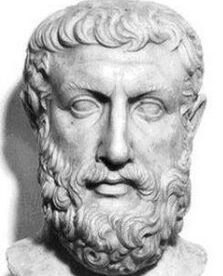
Like Mark Antony, the Reichsmarschall was destined to be the heir to an empire, but lost his inheritance in large part because he lost a private war against his own vices. He too could be an honorable leader, but was often led away into a dishonorable bondage by the force of evil habits. He too had a great capacity for the martial spirit, yet failed to live in accordance with the gallant standards he desired of his men. He too was lured away from the war room and battlefield to vain pursuits—Paris was his Alexandria, art his Cleopatra. And after defeat, he too resolved to die by his own hand rather than endure a victor’s justice.
Göring always saw himself as a soldier, a fact which is made apparent by Irving’s description of his childhood at Veldenstein castle. From those early, delicate years, the boy’s imagination was resplendent with dreams of martial glory, as Irving tells us:1
(27)
Playing knights-in-armor at age eight, Hermann would look down from the battlements and have visions of Roman chariots and of plumed warriors galloping in the valley…He saw himself in sword and buckler, jousting, crusading, triumphing—always triumphing in the end.
The alterations that happen between childhood and adolescence did not change the deeper yearning behind Göring’s happy fantasies: the desire to win honor for himself and defend his Germany. When the Great War broke out, the chance to prove himself finally arrived.
The Knight-Aviator and Fighter Ace
The War did not come for Göring; he came to it. Already an officer in the German army (he had graduated the officer exams in 1913, and had been inducted into the infantry the prior year),2 by the end of 1914 he transferred to the air force, initially as an airborne observer. After spending some time in flight training school, he began to pilot his own fighter plane in October 1915. From that point until the end of the war, he accumulated a reputation as a fierce knight of the skies. The term “knight” is not lightly used here; for Irving, commenting on the nature of aerial warfare at that time, mentions that it maintained a distinctly chivalric culture despite its novelty:3
(34)
The planes were primitive, the pilots daredevils and gladiators; their life expectancy was not long, but if they shot down an enemy officer the man might be dined for days afterwards in the German messes. There was a chivalry toward a defeated foe that did not recur in other arenas or in later wars.
It was within this atmosphere that Göring became a new type of warrior: the knight-aviator. And he thrived as one. By early 1918, he had eighteen kills, ranking him among Germany’s top fighter aces, such as the legendary “Red Baron”, Manfred von Richthofen. He would be awarded the prestigious Pour le Mérite blue cross in May of that year and succeed both Richthofen and fellow ace Wilhelm Reinhard as commander of the famous Jagdgeschwader I in July 1918. When the war ended, he would be credited with a total of twenty-two kills.4 Much like Mark Antony, who became a famous cavalry commander by personally defeating the rebellious King Aristobulus in battle,5 Hermann Göring became a war hero in his twenties.
Göring, as with many other Germans, felt betrayed by the events of November 1918. He would spend the next few years working in Denmark and Sweden in the aviation industry (for his fame as a fighter ace had spread throughout Europe), and during his time in the latter country he met the woman who would become his first wife, Carin von Fock. Returning to Germany with his Swedish love, he would meet Adolf Hitler and join the nascent National Socialist German Workers’ Party in late 1922.
The Injury at the Beer Hall Putsch and His Rise to Power
He would play a leading role in the following year’s Beer Hall Putsch, and like Hitler, stood alongside his fellow brownshirts as they marched against the police, unflinching in their resolve that the coup would succeed. But the police fired, terminating that hope. As the smoke dissipated and bodies lay in the streets, Göring lay prostrate on the ground in a pool of blood, having been shot near the groin. It was a near fatal injury—Irving reports that the round was “only millimeters away from an artery” (61).6
Through the help of Carin and other National Socialists, he was swiftly evacuated out of the country into Austria to evade arrest and receive treatment. It was there that he encountered morphine for the first time, as his surgeons administered it to him to alleviate his intense pain. Little did they or Göring himself know that, in doing so, they had introduced to him what Irving calls “the evil dictatorship of morphine addiction” (83).7 The author follows this by describing the grittiness of the personal conflict that emerged within Göring:
(Ibid)
It was not a public battle. He fought, lost, and won this tragic campaign in the privacy of his own soul.
These moving words are perhaps the most sympathetic lines that Irving produces toward his subject in the whole work. They highlight the most tragic aspect of the Göring story: the war that he fought within himself against this addiction and his other flaws. Indeed, they illustrate that even a supposed persona non grata worthy of damnatio memoriae is still human; anyone who has experienced any addiction or has known others who have can attest to how such a flaw both humanizes and dehumanizes at once. It arouses our sympathy to see someone cripple themselves, but it also arouses our disgust. For to paraphrase Aleksandr Solzhenitsyn, the line that divides good and evil is cut within the soul of every person since we are but fallen men.
But as this private battle raged within Göring’s soul, the coming years would see him able to return to Germany to continue his public battle against the Weimar Republic on his native soil. As a high-ranking National Socialist, he would initially be immensely engrossed in the desperate struggle of a persecuted political party fighting for legitimacy. Due to the appeal of his war hero status, Göring was able to partially cleanse the NSDAP’s maimed public image by making friends and connections in high society. His efforts would prove successful, and Fortune would amply favor him and his party with Hitler’s rise to power in 1933.
This triumph, however, did not come without its own costs—for Fortune, fickle as she is, provided Göring with opportunities for excess, as it does to all who are favored by her. Over a millennium before his birth, Mark Antony had also been favored by this same Fortune after having sacrificed much to defeat the enemies of his leader, Julius Caesar. In the wake of their victories, both men simply took the opportunities for extravagance that she seductively offered as they came, though at great cost to themselves and those under their authority.
The Beginning of the War and His Art Obsession
Though the outbreak of the Second World War was something that Göring attempted to prevent—even going so far as to create a secret diplomatic backdoor to Chamberlain that lasted well into 1940—he oversaw the Luftwaffe’s charge over the skies of Europe as German soldiers and tanks surged into one state after another.
Göring still upheld his ideal of the knight-aviator, and attempted to set the example himself; as Irving notes, he generally “fought a more chivalrous war than his enemies, as befitted the last commander of the Richthofen squadron” (272).8 Despite having set a high standard for his men, he—now much wealthier and much more worldly than the Göring of 1918—struggled on a personal level to emulate the image he admired. His style of leadership can therefore best be described in the same manner that Irving describes his attitude toward the Jews—as having been “beset by inconsistencies” (232).9 In both areas, these inconsistencies were personal, not ideological; but in relation to his command of the Luftwaffe, they developed from a moral failure to embody his own gallant standards.
In the wake of the astounding German victories that culminated in the humiliation of France, Hitler christened Göring with the new title of Reichsmarschall—making him the highest-ranking soldier in the entire German army. He accepted the title eagerly. This increase in prestige made him wish to increase his adornments—he loved art. With Paris under German hands, the capital of the world’s art trade beckoned to him. It was a temptation that he could not resist. Thus he made it a continual habit to board his private luxury train Asia to Paris to “see the latest haul” at the largest of Paris’ art markets then in operation—the Jeu de Paume (302).10 Irving aptly points out the bizarre nature of these aesthetic pilgrimages in the following passage:
(Ibid)
It was a rare spectacle: the highest-ranking soldier in Europe trafficking with “the shadiest collaborationist art dealers, disreputable lawyers, quasi-dealers [and] expert valuers,” as they were tersely characterized in an August 1945 report—“All the riffraff of the international art market.”
These spectacles would continue, even as the war continued and expanded to new fronts. In his fanatical hunt to amass the great paintings and sculptures of the past, Göring, as Antony before him, had fallen under the spell of his Cleopatra.
And as with Antony’s infatuation with Cleopatra, Göring’s obsession with art would prove fatally distracting. The most egregious examples occurred during the Battle of Stalingrad and Operation Overlord, for both were critical battles to win to ensure the Reich’s survival, and required his direct leadership in order to properly ensure air support was given to beleaguered German ground forces. In both cases he would abandon pilots and soldiers for his shopping sprees—just as Antony abandoned his men at Actium to sail after Cleopatra into ruin.11
The Reichsmarschall’s Attempt to Thwart Overlord
Irving paints a quiet tragic irony in his description of Göring’s reaction to the Allied invasion of France. Despite his increasingly strained relationship with the Reich’s leadership after German failures in Russia and North Africa, he still maintained a strong enough relationship with Hitler to discuss the most likely site of a cross-Channel invasion with him and help prepare a defensive strategy. Both men agreed—quite accurately—that either Normandy or the Cherbourg peninsula would be targeted, though most of the generals opposed this view.12
Since the summer of 1943 the Reichsmarschall had been preparing the Luftwaffe for an Allied invasion of Western Europe: he had foreseen this possibility, and it provided him with a chance to restore his honor. He held a private hope that by orchestrating a successful counter-offensive that would rout the Allies back into the sea, he would regain his political authority and prestige. When the time came, however, for the bloodbath of D-Day and its aftermath, Göring was more concerned about the fate of his art than the fate of his men, as Irving relates:13
In France Göring’s ground troops fought well—the badly mauled 16th Luftwaffe Field Division made a heroic defense of northern Caën, while the 88’s employed by III Flak Corps did a lot to halt General Bernard Montgomery’s advance at Falaise. But even at that murderous climax in France, Göring was more concerned with extricating his last treasures to safety. On August 13, he ordered Alfred Rosenberg to evacuate all the works of art from the Nazi repositories in Paris and ship them back to the Reich “without delay.”
(437)
But when news of demoralized Luftwaffe officers retreating into Germany with their own luxuries—”load[ing] trucks with fancy women, chaises longues, and other booty” (Ibid)—reached Göring’s ears, he demanded immediate violent retribution. Animating these episodes, Irving illustrates the pathetic nature of the whole ordeal:
(Ibid)
Weeping with rage, Göring pleaded with Hitler to let him deal with the sinners. He began telephoning his chief judge advocate to demand, “I want death sentences! Where are they!” He realized it was hypocrisy and hated it.
It was Göring’s obsession with art that twisted him from knight-aviator into this almost comical hypocrite. Perhaps it was not too late for him to realize during those turbulent moments of summer 1944—just as it was not too late for Antony in the summer of 30 B.C.—that while beauty indeed has the power to inspire, it can also destroy.
The Fall of Göring
After the fallout of summer 1944, Göring found himself further ostracized. His political and personal misfortunes would cascade into his arrest and imprisonment by the SS during April 1945, as the machinating Martin Bormann snatched his last desperate power grab—an attempt to put into effect Hitler’s 1941 succession decree—right out of his hands by convincing Hitler that his long-time ally was now a traitor. Göring would be freed from Mauterndorf castle by order of Kesselring in early May; sensing the inevitable, however, he voluntarily surrendered to the Americans shortly thereafter.14 Little did he know that his new captors would not treat him as a dignified enemy, but as a war criminal.
When the time came for the Nuremberg Show Trials in November 1945, Hermann Göring would shock the world. For, as Irving states: “Göring had already made the simple decision that eluded his co-defendants in the coming trial: to die like a man” (480).15
He had been discredited as a coward and a dope-fiend; naturally, those who believed these stories thought that he would easily crumble during the proceedings. They were wrong. Just as the harsh conditions of Göring’s imprisonment forced his corpulent body to dwindle in size until his appearance seemed to reclaim that of his youthful knight-aviator years, so too did this imposed frugality seemingly push the man back into that more heroic version of himself. Göring knew that this would be his last battle, and chose to accept death over anything that he felt would compromise the truth. This time, however, the only battle in the skies would be in the airwaves: it was a war of words that would be broadcast across the world.
An Attempt to Atone
His renewed vigor and the clever strength of his oratory alarmed his prosecutors, and gave courage to the German people—co-defendants who were essentially on trial in absentia. Defenseless and brutalized, these millions had survived the horrors of Prussia, Dresden, Berlin, and countless other former strongholds only to be huddled into prison camps like cattle. Narrating the impact of Göring’s astonishing defense on them, Irving recounts:16
(494)
Millions of listeners around the world were hearing the trial broadcast. It was relayed by loudspeaker over prison camps all over Germany, the United States, and Britain. The effect was not what the victors had desired at all. Meals halted, the prisoners poured inside to listen, as Hermann—”Just Hermann! Never anything but Hermann!”—began this last battle for his country. In the courtroom itself the newspapermen were stunned by his performance—they had swallowed their own reports…that the Reichsmarschall was indeed a dope fiend, a physical wreck, a neurotic.
Thus Göring found his own way to atone for his wartime failures in this final resounding success. He could not turn back the hand of time to undo the damage his people had suffered, damage for which he bore considerable responsibility—lives lost, buildings destroyed, cities flattened—but he chose not to abandon them here, after the end of this apocalyptic war. While he could not inflict a physical victory against the Allies, he won a moral victory. He tore down their self-righteous narrative, demonstrating the hypocrisy of their victor’s justice for Germany and all the world to hear. In doing so, he made it apparent to the humiliated Germans that they need not accept the mental guilt slavery of the post-war order, and laid the seeds for future generations to question this order’s triumphalism.
At Nuremberg, Hermann Göring did for Hitler what Mark Antony had done for Julius Caesar in Rome: oratorically assault the new order that branded their masters as tyrants in an attempt to ensure that the enemy did not get the final word over the hearts and minds of the people. Göring’s death would also echo Antony’s—death by suicide. However, both men chose that disgraceful act in very different circumstances. Antony committed suicide after fleeing to Egypt in the wake of the disaster at Actium, fearing that Octavian would impose upon him and Cleopatra the sort of victor’s justice that the Allies imposed upon Göring.
It was then Göring who must be considered the braver in this respect. For he chose not to end his own life with his beloved second wife Emmy when the war neared its end, but instead entered his enemies’ captivity. And though they betrayed his trust, he chose to live long enough to fight in his final battle on behalf of Hitler, the German people, and indeed, what he saw as historical truth itself. Examining Antony’s case, however, one finds that he was simply too attached to Cleopatra at that point to think of defending anyone beyond her. He wished to die with her, but failed even at this; for Cleopatra would survive their suicide pact, yet would take her own life at a later date.17 There was no final defense of his cause—there was only a lover’s despair. The warrior within Antony was gone; but within Göring, it had only gone dormant.
Closing Thoughts
In the end, what Irving achieved in this biography for Göring is simply excellent. The author commands the reader’s attention with a captivating narrative prose, for he grants the reader a realistic, detailed portrait of his subject that does not overload the mind with information. His work in this respect is markedly similar to what R.H.S. Stolfi would accomplish decades later in his Hitler biography: both historians allowed their controversial subjects to speak for themselves without front-loading their text with the typical moralizing found in most other biographies about these men.
There are many details that the author of this review could not find the space to address in this review—and among them, the subject of Göring’s religious views stand out particularly. They will therefore be mentioned here in brief. Irving relates that while Göring was “born and confirmed…as a Protestant” (28), he did briefly attend a Catholic school for a short period of his boyhood.18 By the end of his life, however, he would appear to have adopted Arian views. Pastor Henry Gerecke, the Lutheran chaplain assigned to the Nuremberg defendants, stated that while Göring claimed to be a Christian, he denied the divinity of Christ and did not accept Christ’s teachings.19 It is intriguing, however, to note the frequent mention of and appeals to God in the Reichsmarschall’s last letters.
With this added information in mind, one can further see the similarities that Hermann Göring strikingly bears to Mark Antony—especially in their duality of character. Göring would have himself believer and unbeliever, just as he and Antony were brilliant and foolish, disciplined and extravagant, brave and frivolous, humane and inhumane. This duality in both men was not buffoonery; it was tragic grandeur, their hamartia. If one’s vices are not violently fought against, they will force that person to violently contradict their own sense of honor: because Antony and Göring did not overcome their evil habits, their causes and futures were sabotaged by themselves. Irving allows the reader to see this dimension of Göring’s character and how it deeply impacted his role in history, thus simultaneously rendering Göring: A Biography a superb historical study and cautionary tale. It is therefore recommended to the sincere reader of history and politics.
-
Irving, David. Göring: A Biography. First edition. William Morrow and Company, Inc. 1989. Chapter 1: “A Triangular Affair.” p. 27.
-
Ibid. Chapter 1: “A Triangular Affair.” p. 32. -
Ibid. Chapter 1: “A Triangular Affair.” p. 34.
-
Ibid. Chapter 1: “A Triangular Affair.” pp. 36-37.
-
Plutarch. “Antony.” The Lives of the Noble Grecians and Romans. Translated by John Dryden. Great Books of the Western World. Vol. 14. Encyclopædia Britannica. 1971. p. 748.
-
Irving, David. Göring: A Biography. Chapter 3: “Putsch.” p. 61.
-
Ibid. Chapter 5: “Asylum for the Criminally Insane.” p. 83.
-
“He employed the tactical air force with moderation during the 1939 Polish campaign; although the contemporary British and French propaganda claimed differently, the captured secret dispatches of the French air attache in Warsaw, later published by the Nazis, documented this unexpected restraint. On Hitler’s orders, in the first days of the war Göring issued orders that sharply limited the operations of his crews—forbidding them to use poison gas, to attack civilian targets, or to sink Red Cross ships, and flatly embargoing London as a bombing target.”Ibid. Chapter 23: “Doctor Ready to Become Boss.” p. 272.
“He set a high standard of conduct and brooked no laxity…Airmen guilty of drunken crimes of violence were inevitably court-martialed, and rapists could expect short shrift…in the case of one Russian rape victim, Göring ordered the felon to be hanged in her home village.“
Ibid. Chapter 24: “Yellow and the Traitors.” p. 282.
-
“While the doctrinaire Nazis fought the Jews at every level of their existence, Göring fought only certain Jews, and on a much narrower front. The economic factor underlay all his directives against them.”
Ibid. Chapter 19: “Sunshine Girl and Crystal Night.” p. 232.
-
Ibid. Chapter 26: “The Art Dealer.” p. 302.
-
Plutarch. “Antony.” The Lives of the Noble Grecians and Romans. p. 772.
-
Irving, David. Göring: A Biography. Chapter 38: “Imminent Danger West.” p. 422.
-
Ibid. Chapter 40: “Witch Hunt.” p. 437.
-
Ibid. Prologue: “Arrest the Reichsmarschall!” pp. 18-22.
-
Ibid. Chapter 43: “Fat Stuff.” p. 480.
-
Ibid. Chapter 44: “On Trial.” p. 494.
-
Plutarch. “Antony.” The Lives of the Noble Grecians and Romans. pp. 778-779.
-
Irving, David. Göring: A Biography. Chapter 1: “A Triangular Affair.” pp. 27-28.
-
Ibid. Chapter 45: “Release.” pp. 508-509.