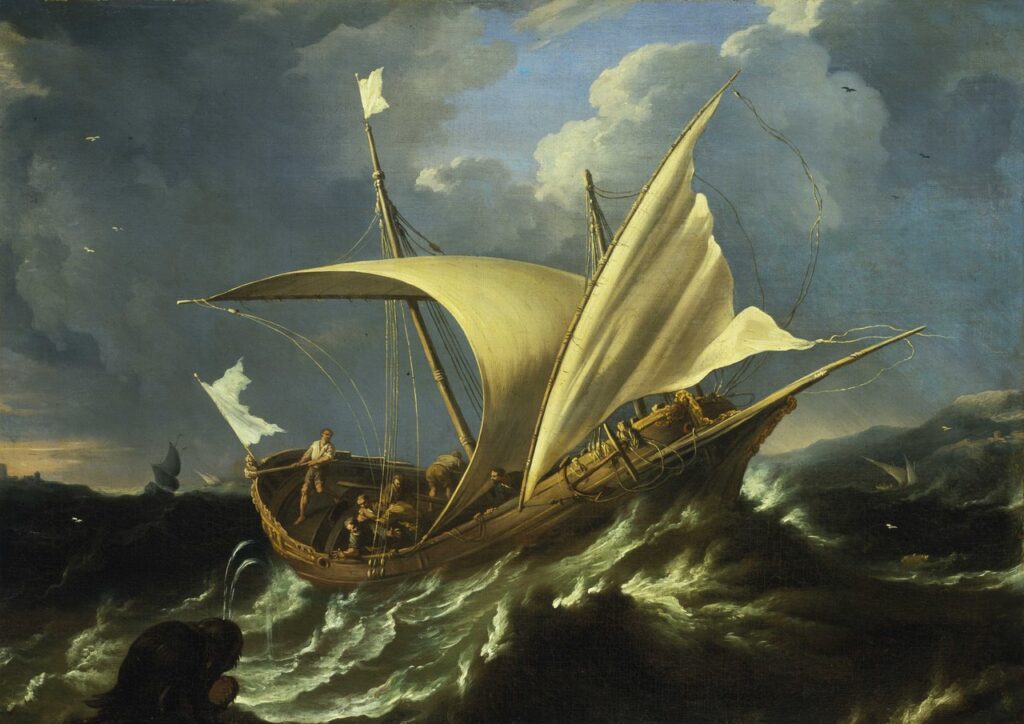
Jonah and the Whale by Carlo Antonio Tavella
Available from Abebooks, Thriftbooks, and Amazon
Book Length: 254 pages
Guilt is awful in its universality. For it rears itself not only in social life, but also in the silence of one’s very soul. Unsurprisingly, the temptation to downplay or outright deny this sense becomes an attractive temptation; and in no other aspect of life is the sense of guilt assaulted more than in religion. It is common in psychological circles to label even the most sensible pangs of guilt connected to religious belief as “mentally harmful” or “traumatic”—and in the place of religious belief, these professionals would have us adopt the secular humanist doctrine of the inherent goodness of all men (except White men, of course). There are even “recovery groups” organized by ex-Catholics with the aim of helping their fellow apostates escape the pangs of conscience that God uses to recall them to the “abiding Goodness which holds out / Its open arms to all who turn to It” (Purgatorio III. 122-123).1 Yet for all their fervor, these worldlings cannot escape guilt, for they deny the very means by which it can be effaced. Guilt is a penalty of sin, and since sin entered the world it is as much a part of the objective order of the universe as the sun and the moon.
Flannery O’Connor’s Wise Blood is a profound exploration of the tension between free will and the objective weight of sin. The spiritual conflict experienced by the novel’s protagonist, Hazel Motes, illustrates that while one is capable of dimming one’s own conscience, the reality of guilt is inescapable; and parallel to this, that the soul, wounded by original and personal sin, yearns for redemption.
Like Jonas, we can attempt to flee from God to our own Tarshish—but He is omnipresent; thus the possibility to do His Will remains to us, so long as we live. Providence offers chances for those who have refused grace to accept it, even in ways that easily bruise our sense of comfort. In this sense, Hazel is something of a Jonas figure: he is a man who has formulated a grand scheme to unburden himself, though not of a prophetic mission, but of God Himself; for like many worldlings, he sees in his belief in Jesus the cause of his guilt, rather than the sweet yoke that alone can cleanse his inner pain.
Yet Christ will not entirely abandon Hazel Motes—not the sad and spiritually wounded boy we see in flashback sequences, nor the man, physically and mentally scarred by war, who returns to his practically abandoned Southern hometown of Eastrod with the aim of leaving everything from his past behind him, including his faith. The hidden pursuit of Hazel’s soul by Jesus, in spite of all that Hazel does to outrun Him, forms the true conflict of this novel. This is even directly hinted at in a flashback in the very first chapter, in which Hazel is depicted as having imagined Jesus moving “from tree to tree in the back of his mind” sometime in his youth (16).2 It is as though he is imagining Jesus, a “wild ragged figure” to him, actually pursuing him and trying to get him to go somewhere—”motioning him to turn around and come off into the dark where he was not sure of his footing, where he might be walking on water and not know it and suddenly drown” (Ibid). Hazel does not trust this “figure”, whom he perceives as suspicious rather than benevolent; he trusts in himself.
While on the train out of Eastrod, he encounters a number of strangers. Underlying all these interactions is his desperate attempt to flee from his own past. Despite having “escaped” Christ, he cannot seem to stop talking about redemption, even though he denies the need for it. This irony is further enhanced by his attire, as his large black hat is reminiscent of a preacher’s hat. While Hazel is aware that others on the train perceive him as a preacher, in each conversation he has in this sequence he is the first one to bring up religious matters, but with a peculiar atheistic zeal. For instance, when he is seated across from three “youngish” women on the train for a meal, there is an awkward silence before he makes a declaration that initiates this revealing exchange:
“If you’ve been redeemed,” he said, “I wouldn’t want to be.” Then he turned his head to the window. He saw his pale reflection with the dark empty space outside coming through it. A boxcar roared past, chopping the empty space in two, and one of the women laughed.
“Do you think I believe in Jesus?” he said, leaning toward her and speaking almost as if he were breathless. “Well I wouldn’t even if He existed. Even if He was on this train.”
“Who said you had to?” she asked in a poisonous Eastern voice.
He drew back.
(10-11)
At the end of this interaction, Hazel finds something that shocks him—indifferentism. All he has known before this is either belief or unbelief: either someone believes in Jesus or they do not. That anyone would suggest that this belief matters little, that it is only a choice among many—as the “Who said you had to?” comment clearly suggests—is foreign to his Southern upbringing and his time in the military. He thus draws back out of surprise. In his rebellion against God, he expected to repulse her with his open declaration of unbelief—but this young woman’s “poisonous Eastern voice” questions the need to even care about belief in Christ in the first place. In doing so, she voices a lack of concern for what should be a decisively offensive statement; he intended to offend her with unbelief, but her indifferentism offends him. Hazel’s apostasy has not changed the fact that belief in Christ is of great significance to him, and neither has it changed the reality of the guilt which he still carries within himself.
Hazel’s reaction to indifference unveils a deeper truth: he considers it necessary to attack belief in Christ openly, because he cannot silence his own conscience internally. In his mind, if he can “defeat” Jesus by winning others over to unbelief, his guilty acts will be cleansed.
Long before his return to Eastrod after the war, Hazel was attempting to run away from his past. In a flashback scene set during Hazel’s boyhood, he is let into a circus tent within which, to his surprise, he sees a naked woman for the first time. When he returns home, his mother, observing him with the eyes set within her “cross-shaped face” (59), notices his changed mannerisms. She sees her son, now guilt-ridden. He has done something evidently very wrong, and she gives him the chance to confess it—but he refuses. Even after being hit by her with a stick, he refuses to admit what he saw. She even tells him, “Jesus died to redeem you”, but his muttered response is “I never ast him.” Already as a child, Hazel begins to treat Christ’s redemptive sacrifice as something unnecessary for himself, something that should be subject to his own will. However, a stern, silent look from his mother’s face after these words make him realize even beyond the “guilt of the tent” there resides a “nameless unplaced guilt within him” (Ibid).
This realization leads to him attempting an act of reparation the very next day in an oddly Catholic manner for a Protestant boy: he fills his shoes with stones, ties them tight, and walks a mile and a half in them. He does this with the firm conviction that this act “ought to satisfy Him” (60). This exercise was therefore not a product of sadomasochism, but an instinctive response to the need for penance. Yet when no direct sign from God comes to indicate His approval, Hazel becomes despondent. Somewhere from boyhood to adulthood, then, Hazel went from believing God does not care about me to God does not care because He does not exist. Because he loses faith in the power of God’s grace, Hazel Motes chooses to invent his own solution to the problem of guilt.
No matter how much Hazel tries to distance himself from his past, he cannot escape it. Indeed, the very means by which he attempts to destroy his past and his faith prove it: like the grandfather he bears a striking resemblance to, he becomes a preacher, though an atheist preacher rather than a Protestant one. He is drawn to publicly convert others to his belief in order to redeem them—as did his grandfather—but instead of preaching belief in Christ to save the souls of others, Hazel preaches rejection of Christ in order to liberate his hearers from their own guilt. Thus, he creates an anti-gospel.
The irony involved in his bizarre evangelization is best explained through the symbolism latent in his name. Hazel Motes is in an intellectual and spiritual haze (in fact, other characters often shorten “Hazel” to just “Haze” when speaking to him, as though O’Connor wants to make this connection easily recognizable) and he cannot take out the mote in his eye before attempting to “convert” others (cf. Matthew 7:3-5). He is therefore blind to the absurdity of his newfound quest to redeem himself and others from the need for redemption.
It is his fixation on disproving Jesus to prove his innocence that highlights rather than eliminates his need for redemption; he cannot cleanse himself of his guilt, no matter how many others he can convince that he is clean. This quest reaches its pinnacle when, while preaching from the hood of his beat-up car to a group of listeners, he suddenly breaks out into an appeal for another Christ:
(140-141)
“Listen here. What you need is something to take the place of Jesus, something that would speak plain. The Church Without Christ don’t have a Jesus but it needs one! It needs a new jesus! It needs one that’s all man, without blood to waste, and it needs one that don’t look like any other man so that you’ll look at him.”
He thus changes the teachings of his new “church”: beforehand he preached the idea that “[n]othing matters but that Jesus was a liar” (101), but in this later scene he states the need for a “new jesus” to take His place. It is as though he realizes that Christ cannot simply be dismissed as a “liar”, that a better tactic to discredit Him would be to try to find another to replace Him, since he still years to achieve salvation—though a libertine or nihilistic version of it, a salvation through killing the conscience—and believes that others must want this in some way as well.
Hazel is then committed to finding the truth, though goes about it in a very faulty direction. Yet, this disposition proves him more honest than most of the other characters in this novel—thus truly a possessor of “wise blood” by its end.
This work is an astounding exploration of the hidden power of grace, and how it incarnates in our world. O’Connor does indeed use the grotesque, whether it be through the unpleasantness she paints in her characters or the cynical, indifferent, and vicious air that colors the city of Taulkinham and its surroundings. But these are never done to the point of excess, and they exist to demonstrate the dark reality of our fallen world—and in particular, the Christ-hauntedness of the South.
This Christ-hauntedness exists not on account of the existence of any particularly weird ghoulish persons or places, but as the result of a real absence. And this absence is the absence of the True Presence of Our Lord Jesus Christ. For O’Connor, as an Irish-Catholic native of the Protestant-dominated South, observed in her homeland the odd legacy of a place that outwardly professes so much belief in Jesus but in reality takes His promise of redemption for granted. It lacks the fullness of Catholicism, especially in its rejection of the doctrine of transubstantiation and the need for penance—which lead to its inhabitants often reducing Christ to a distant moral example. Hazel’s character demonstrates the deeper spiritual hunger for penance and the presence of Christ that is not satisfied by this atmosphere. He performs a penitential act in his boyhood, but because he has not been taught that God is like “a whistling of a gentle air” (3 Kings 19:12) he is set down the road of gradually losing faith in Him. There is no confession for Hazel to make to a priest because he has been raised in a religion that preaches private judgment against sacramental hierarchy, healing, and presence. Then as an adult infidel, he demands a “new Jesus” because he refuses to find the real Christ, and cannot see Him in the charlatans who masquerade as street preachers.
This is therefore a book surely to be recommended to those readers of fiction who would like to see something of the great mysteries of grace, free will, and the problem of guilt admirably depicted.