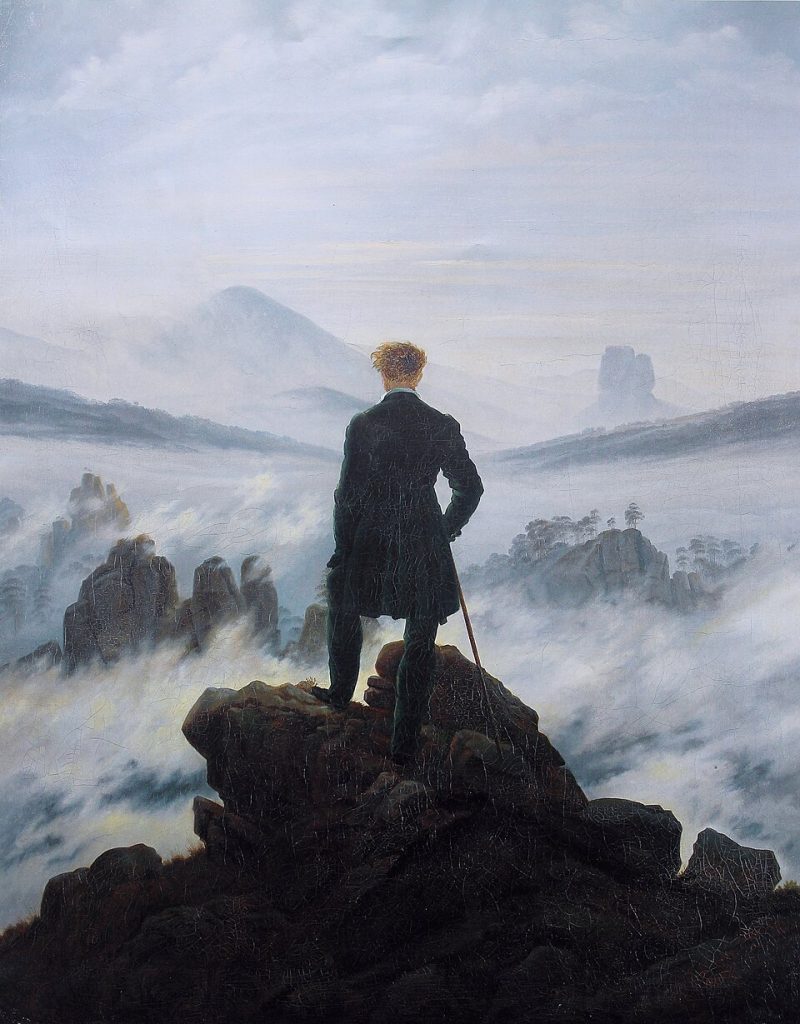
The Wanderer above the Sea of Fog. Oil painting by Caspar David Friedrich (1818).

Available from Amazon and Thriftbooks
Book Length: 128 pages
Our age, infested with emotionalistic moralism and unbounded in its lust for all things technological, has made C. S. Lewis’ urgent appeal in The Abolition of Man all the more worth revisiting. Indeed, men are “abolished” in more ways than one in the modern world, with the state’s tacit support of feminism, pornography, and degenerate sexualities being the most evident to anyone with eyes to see and ears to hear. In this work, however, Lewis targets the foundational problem behind these ills: the loss of objective moral values.
Starting from examining an example of textbook authors who frame art as having no objective standards to their impressionable audience of elementary students, Lewis builds his argument from art to morality. He sets against these authors and all similar innovators what he terms the Tao (Chinese for Way), which he defines as “the doctrine of objective value, the belief that certain attitudes are really true, and others really false, to the kind of thing that the universe is and the kind of things we are” (18).1 This is simply a rephrasing of the Natural Law, as he admits in another place in this work; he uses an unfamiliar word for a familiar concept in order to highlight the universality of this doctrine across all races of men to his Western audience.
He bolsters this point by frequently referring to the sayings and teachings of the famous philosophers, teachers, and sacred texts of Antiquity in the four chapters of this work. He does not stop there, however. For Lewis has affixed an appendix over twenty pages in length, divided according to various moral subjects, with numerous quotations representative of varying religious and ethical systems that explicate the Tao. The witness of such ancient authorities to the Natural Law is certainly quite thought-provoking: however, Lewis is at his finest when he demonstrates how the abandonment of this objective moral system must necessarily lead to a world governed by the tyranny of subjective cravings. Summarizing this grave danger, he warns in a particularly brilliant sentence that:
When all that says ‘it is good’ has been debunked, what says ‘I want’ remains.
(65)
But who gets to say “I want”? Lewis does not shy away from the answer to this question: rightly he points out that there are—as is natural in any society—a quantity of persons who are influential enough to mold the population by virtue of their high position. If these elites reject the Tao, they become what he calls the Conditioners. These persons no longer seek to hand down traditional morality, but make a law unto themselves that they impose on the masses, hence conditioning them.
Their “new law” is purely subjective; for while the Tao can be developed from within, one tenet of it cannot logically be held while denying the existence of the rest. As Lewis writes: “From within the Tao itself comes the only authority to modify the Tao” (47). For it is illogical to claim that there is no objective right and wrong in one sentence, and then in the next to bewail slavery as an absolute, unquestionable evil—an error that the infamous atheist Christopher Hitchens repeatedly made. These Conditioners thus “must come to be motivated simply by their own pleasure” (65), because having rejected objectivity, their subjective feelings are all that is left for them. Such a state is truly perilous for them and those molded by their institutions; and Lewis, seeing to the end of what this process must entail, declares:
(64)
Stepping outside of the Tao, they have stepped into the void. Nor are their subjects necessarily unhappy men. They are not men at all: they are artefacts. Man’s final conquest has proved to be the abolition of Man.
Thus man’s rebellion is his unmaking: how little has changed since Adam! By severing man from the Tao, the Conditioners have not freed man—they have abolished him. They have abolished him by enslaving him not only to themselves and their technology, but also to Nature itself. For Lewis, delineating this process, continues:
(67-68)
Nature, untrammeled by values, rules the Conditioners and, through them, all humanity. Man’s conquest of Nature turns out, in the moment of its consummation, to be Nature’s conquest of Man.
This may appear odd, for the typical idea (both in Lewis’ time and ours) is to envision man using technology against Nature to control it. Lewis sees a much deeper conflict: Nature gaining absolute control over man through man’s reliance on technology. He observes that man begins by evaluating the natural world in terms of a materialistic “Nature” to be valued only “in terms of quantity” (69) that must be scrutinized, corralled, and dominated. Then, man reduces mankind to mere natural beings within this system—flesh and blood, without a soul, “men without chests” (26)—thus making himself a part of his own rationalistic abstraction of Nature that he seeks to totally control, and so preparing himself to fall victim to the horrible consequences of this abstraction.
The main flaw in this text, however, is that Lewis never explicitly takes his argument to the place where it must lead: man’s self-destruction through this process is not merely the conquest of Nature over man—it is also the conquest of fallen nature over man. For without an adherence to objective moral law, man is destined to be enslaved to the cravings of fallen nature, and technology will be used to make this enslavement more potent, more addicting. The Conditioners know this, and accept the price of their own humanity for their pleasure-based domination. Nature thus conquers man through fallen nature, both morally and intellectually. For what else is the rationalization of Nature but a conceit of man’s pride? One does not have to be within the fold within the Church to understand this, for the Eastern sects and the Protestants (such as Lewis himself) likewise hold the doctrine of the Fall.
On the contrary, Lewis excludes even mere Theism from the Tao, for he writes in one place: “I am not attempting any indirect argument for Theism” (49). In this way, he turns the Tao into an objective moral law that is only rational, lacking any recourse to divinity.
While he rightly concedes that the traditional moral systems cannot be combined, for such a synthesis would contain “many contradictions and many absurdities” (45), it does not disprove the idea that all these systems claimed some form of divine origin. One can in fact see that all the representations of the Tao that Lewis himself references in this work were linked to some spiritual system; it would have only helped, not hindered his argument to include the fact that the Tao was always believed to be of divine origin and therefore immutable by man’s will.
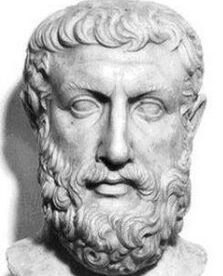
The Natural Law, the law written on man’s heart (cf. Romans 2:14-15), must ultimately refer to God in the end, or else it becomes a law that man can change. For if we exclude divinity from it, do we not imply that “man is the measure of all things,” as Protagoras said?2 If the Tao is not divine and man is the highest moral agent in the universe, then it is not truly immutable, for it grew out of man’s intrinsic need for rational order—an order that perhaps man, through technology, can alter. But if the Tao is divine, then to follow the Tao is to participate in a divine order—a hierarchy—that stands above man and is thus immutable.3
Despite this fault, however, this work is recommended. The problem diagnosed by Lewis has unfortunately continued, and even the most attentive mind of our time will obtain a greater perspective of it after a careful reading of this prescient book.
-
All quotations of this text are provided from:
Lewis, C. S. The Abolition of Man. HarperCollins. 2001.
-
Plato. Theaetetus. Translated by F. M. Cornford. Plato: The Collected Dialogues edited by Edith Hamilton and Huntington Cairns. Princeton University Press. 2005. p. 856.
-
See for reference Fr. Copleston’s explanation of the teaching of St. Thomas Aquinas on the Natural Law:
Fr. Copleston S.J., A History of Philosophy, Vol. II: Medieval Philosophy. p. 409.
As God is eternal and His idea of man eternal, the promulgation of the law is ex parte Dei, though it is not eternal ex parte creaturae. This eternal law, existing in God, is the origin and font of the natural law, which is a participation of the eternal law. The natural law is expressed passively in man’s natural inclinations, while it is promulgated by the light of reason reflecting on those inclinations, so that inasmuch as every man naturally possesses the inclinations to the end of man and possesses the light of reason, the eternal law is sufficiently promulgated for every man.