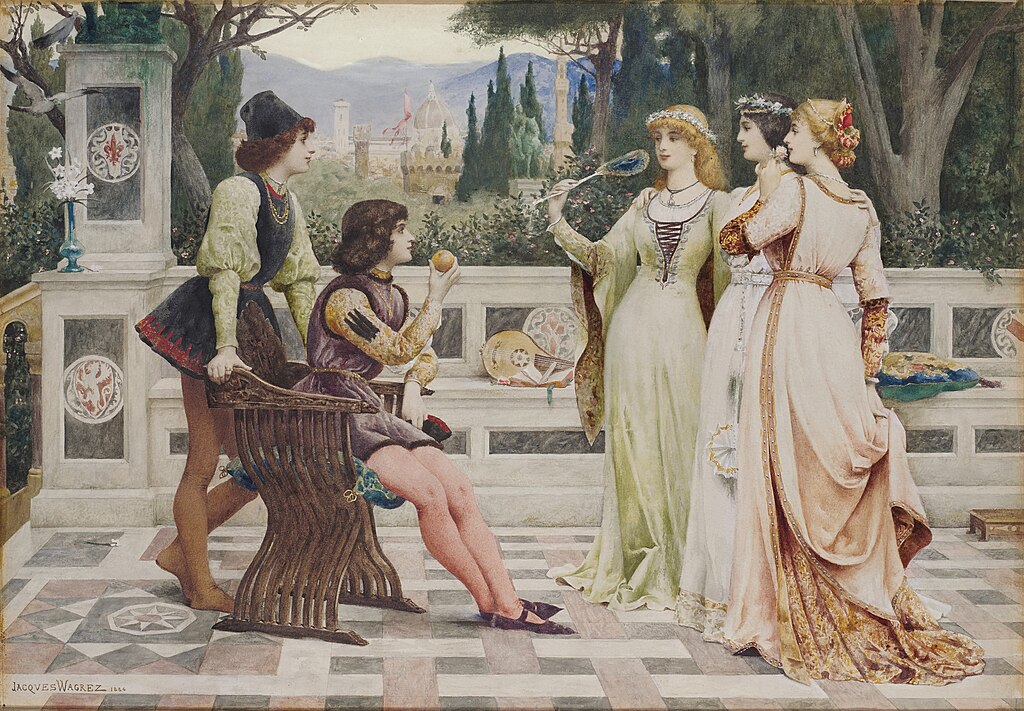
The Judgement of Paris by Jacques-Clément Wagrez (1886)

Much has been uttered about the problem of political and social polarization in the United States; yet despite the recurrent discussions, no new insight is actually gained. Even after the assassination of Charlie Kirk made the fanaticism of the Left apparent for all to see, many “conservatives” still prefer to engage in debate with those who would applaud their death. The anointed voices of our limp-wristed institutions may well plead pathetically for tolerance and kindness in our “difficult times”—but to what end? Do they ever truly delve into the source of the division? Never.
Politicians and pundits alike superficially answer it by making pathetic appeals to a renewed faith in a hopelessly corrupt system, an “experiment in democracy” which has ended in combining the three worst forms of government—tyranny, oligarchy, and mob rule. How else can one explain the rampant disenfranchisement of our native stock through mass immigration, the nefarious lobbying racket in Washington D.C., and the empowerment of the feminist philistines who vote for the “right” to slaughter the unborn? Yet, the confessors of democracy urge us not to apostatize. They beg the public to not lose faith in “our democracy”, while in the next sentence—or even in the same one—they will praise its pluralism, its diversity. A curious statement, indeed: why praise the pluralism of races, religions, cultures, and even “sexual identities” in this country, but deny the dignity of pluralism to anti-democratic ideologies? Such schizophrenic statements evoke the sensationalist messaging of the Chinese Communist Party to its subjects—without “our democracy”, there would be no America!
Reading between the lines of this absurd rhetoric, one observes a deeper problem: the lack of common standards in the United States. The politicians and pundits’ appeal to unity around the principles of American democracy is worthless, because it will rightly be followed by this question: “What are those principles?” To that question, these Washington’s Witnesses will produce mutually exclusive answers, depending upon their interpretation of the tenets of the American civic religion.
This trouble ultimately derives from the conflict over the place of religion in American society that preceded and followed the Revolution. Since the colonies were dominated by a populace of self-identified Christians that shared no unity of church affiliation, this was to be expected. The exaltation of so-called “Enlightenment” values by the revolutionaries, however, would only further complicate the issue. Hence, the resulting discord surrounding the matter of religion was inevitable. While some founders, such as Thomas Jefferson1 and Thomas Paine, favored secularism, others such as Samuel Adams2 and Patrick Henry3 favored Christian influence in social and political life.
Despite the First Amendment’s prohibition against establishing any form of state religion at the national level (the individual states themselves being a different matter),4 Christian values have been intrinsically united to the American identity. Witness one statement among many which can be quoted on this subject that was offered by the famed nineteenth-century French observer Alexis de Tocqueville:5
(De Tocqueville 305)
…[T]he revolutionists of America are obliged to profess an ostensible respect for Christian morality and equity, which does not permit them to violate the laws that oppose their designs; nor would they find it easy to surmount the scruples of their partisans if they were able to get over their own. Hitherto no one in the United States has dared to advance the maxim that everything is permissible for the interests of society, an impious adage which seems to have been invented in an age of freedom to shelter all future tyrants.
Thus the American conception of liberty was intrinsically connected to Christian social values; how far removed is this from the licentious understanding of today! Lamentably, it is evident that the “impious adage” which Tocqueville mentions has indeed served to “shelter all future tyrants”; we daily suffer under them. They have used the “interests of society” to advance such abominations as abortion on demand, sodomitical sham marriages, and transvestite mutilation rituals. They have made the disgusting and the barbaric seem virtuous by moralizing to our people that it is in the “interests of society” for these things to be tolerated—and even celebrated.
And what occurs when one speaks against these “interests”? The possible consequences are many: shunning, mandatory “sensitivity training” sessions, loss of employment, and public denouncement by means of the Internet are the most likely. It is then the case that secular humanistic political correctness has displaced Christian morality in the contemporary United States, and is enforced upon the people with an iron rigor. How then did Americans fall under this tyranny?
It came about through the abandonment of Christian social morality for secular humanistic political correctness. This apostasy was no thief in the night; it was the culmination of the centuries’ old contest between secularism and religiosity that fused Jefferson’s ideal of the “wall of separation” with an extension of the Protestant principle of private judgment to justify the creation of an American laïcité. Consequently, the previously Christian sense of liberty that had permeated American law and society was replaced with its revision, the libertine spirit of the nineteen-sixties. Perhaps no statement better encapsulates this a priori redefinition than the following infamous words:6
(Planned Parenthood v. Casey)
At the heart of liberty is the right to define one’s own concept of existence, of meaning, of the universe, and of the mystery of human life.
Though it may sound profound at first, this “heart of liberty” falls apart upon further examination. For an attentive study of human nature indicates that most people simply lack the resolve to undertake the sort of intellectual quest that is necessary to “define one’s own concept” of any of the listed criteria. How many have sailed calmly through the pages of the Holy Bible and the sacred texts of other faiths, and continued their soul-seeking voyage through all nine volumes of Copleston’s A History of Philosophy?And of these, how many came finally to the safe harbor of their own “concept of existence, of meaning, of the universe, and of the mystery of human life” through contemplating the great ideas contained within those works? The author of this article has met not even one such person—and you, dear reader, have probably met no such person yourself.
The promise of unfettered intellectual and spiritual freedom is a burden too great to bear for even the highly intelligent, let alone the mass of men. The latter choose to live unexamined lives, and use their “freedom” to take the path of ease—to adopt the morality of the American civic religion, which teaches the nineteen-sixties revision of liberty through the state-run public education system, which the Calvinist theologian Rushdoony rightly termed “the established church of these United States.”7 Be not mistaken: like any organized faith, it has doctrines. Though it emphasizes “inclusion” and “diversity”, the generous latitudarianism of the public school only extends to those who share the same liberal egalitarian principles as themselves. Accordingly, any viewpoint that falls outside of this worldview falls under their intolerance. Most of all they despise the traditional White Christian identity, hence they damn it as racist, sexist, antisemitic, homophobic, Islamophobic, colonialist, etc.
In tandem with this vast system, the mass media merely composes a reinforcing mechanism for the people and a reeducation program for adults who were not available for the first round of their Americanist catechism lessons. Such powerful institutions are difficult to ignore and militate against for Americans, even if one is fortunate to have been insulated from these corroding powers by their parents. For in this “democracy”—and in all democracies as Aristotle defined them—if one does not follow the opinions of those demagogues who control the mob, then one is an enemy of “the people”.
In theory, therefore, the American people are free to choose their belief systems; in fact, they are subtly pressured into adopting the morality of the state. Secular humanism has duped the American people; like Satan, its false prophets have promised them that “you shall be as Gods, knowing good and evil” (Genesis 3:5)—only to make them slaves of a new Babylon.
As with all hypocrisies—no matter how subtle—deceit essentially leads to the ruin of contradiction. Hence the collapse of Christian social values in favor of secular humanist libertinism has ended in the epistemic divorce of what American liberty even means.
Foreigners who would have been refused entry before the Hart-Keller Act have a “right” to migrate to the United States because this is liberty; banks force homeowners into usurious mortgages because this is liberty; mothers deliver their infants to the abortionist slaughterhouse because this is liberty. These are the products of the libertine revision of liberty. Yet the immigration quotas, strict usury limits, and the crime of abortion that were all enshrined in the laws before the turbulence of the sixties clearly indicate the Christian sense of liberty. Thus the spirit of the laws is roughly divided between two ages: the Republic before 1965 and the Republic after 1965. While American conservatives ought to defend the former spirit, they often end in conserving the latter. The American liberals, on the other hand, are unequivocal—they do not flinch from the jihad of imposing the former spirit.
But when conservatives do attempt to conserve the older spirit, this further reveals the rupture. If—as famously happened less than a decade ago—liberals and conservatives both cite the same constitution to assault or defend a man who, on the basis of his Christian values, refuses to bake a wedding cake for two sodomites, does this not indicate the incoherence of the Americanist creed? It has suffered the same fate as Protestantism: unity in name only. The constitution is the Scripture of the American civic religion, and liberty its grace; thus Dryden’s critique of the Anglican church rightly applies:8
As long as words a diff’rent sense will bear,
And each may be his own Interpreter,
Our ai’ry faith will no foundation find
The word’s a weathercock for ev’ry wind:
The Bear, the Fox, the Wolfe by turns prevail,
The most in pow’r supplies the present gale.
(I. 462-467)
The Americanist state can be analogized to a high church and the faithful common people its low church. Among and inside these realms doctrinal wars are waged to maintain or overthrow the post-1965 regime. This is a crisis of legitimacy; the Americanist state, as the established Church of England before it, is forced to battle dissenters from within and outside its fold while attempting to preserve a consistent body of teaching. Understandably, this conflict is made all the more arduous given that both these governments were born of usurpations that justified themselves on the principle of private interpretation or the liberty of conscience—two principles that are really one and the same. It was this relativism that was weaponized into an unstable unity, a rallying cry to topple the sane liberty of Christian order.
The American civic religion has therefore destroyed American liberty by means of its “wall of separation” between Church and State. For this vaunted separation ends with the State claiming absolute moral authority for itself. Thus, the State becomes the Church—a detestable tyranny.
Must Americans then wander in the darkness, with no true light to guide them? No! There is indeed a shining city on the hill—and that city is Eternal Rome.
She is the one font of civilization and religion. In her alone there is both the heritage of the universal empire and the perpetual work of the universal Church. This is not to argue, however, that one ought to follow the impostors in the Vatican because these new pharisees have created a new church. They have made their authority void because they have betrayed the Catholic religion in favor of the same ambiguities that have ruptured both Protestantism and Americanism. Hence the internecine arguments over matters of faith within their Roman Protestant Church that had been considered long settled before the so-called Second Vatican Council.
For the genuine Catholic Church, the present crisis is one of many. She has weathered other storms. In doctrine, she has survived the terrible revolts of Arius and Luther; in morals, she has overcome the scandal of the pornocracy and the piratical swindling of the simoniacs. Even if one does not have faith, one must admit that for any institution to endure such crises is simply extraordinary, especially over a period of nearly two thousand years.
God is Truth; He cannot contradict Himself. Read St. Paul: “One Lord, one faith, one baptism” (Ephesians 4:5). All these are preserved in the authentic Roman rite, and are expressed by the traditional Catholic doctrines and principles which have, though in obscurity, have continued down to our time. It is this spiritual unity that formed Europe out of the collapse of the Western Empire, and it is this same unity that will provide the necessary weltanschauung to reform the West. For unlike the American civic religion, it is this Catholic unity that is capable of reforming itself when its principles are attacked from within.
-
“Believing with you that religion is a matter which lies solely between Man & his God, that he owes account to none other for his faith or his worship, that the legitimate powers of government reach actions only, & not opinions, I contemplate with sovereign reverence that act of the whole American people which declared that their legislature should “make no law respecting an establishment of religion, or prohibiting the free exercise thereof,” thus building a wall of separation between Church & State.”
– Thomas Jefferson to the Danbury Baptist Association. 1 Jan. 1802. Founders Online.
https://founders.archives.gov/documents/Jefferson/01-36-02-0152-0006. -
“It is the interest of tyrants to reduce the people to ignorance and vice, for they cannot live in any country where virtue and knowledge prevail. The religion and public liberty of the people are intimately connected: their interests are interwoven; they cannot subsist separately, and, therefore, they rise and fall together. For this reason, it is always observable that those who are combined to destroy the people’s liberties practise every art to poison their morals.”
– Samuel Adams, “Valerius Poplicola.” Boston Gazette. Oct. 5 1772.
Wells, William V. The Life and Public Services of Samuel Adams. Boston: Little, Brown & Co. 1865. Vol. I. p. 487.
https://archive.org/details/lifeservsamadams01wellrich/page/486/mode/2up.See also:
Samuel Adams and the Second Continental Congress. “National Thanksgiving Proclamation.” 1777. Wikisource.
https://en.wikisource.org/wiki/National_Thanksgiving_Proclamation_(1777). -
See for reference the following bill that Henry endorsed:
Henry, Patrick. “A Bill Establishing a Provision for Teachers of the Christian Religion.” 1784. Contextus.org.
https://contextus.org/Patrick_Henry%2C_A_Bill_Establishing_a_Provision_for_Teachers_of_the_Christian_Religion.2?lang=en.See also this article, which discusses how Henry veered into a pragmatic endorsement of Christianity:
Rogers, James R. “Patrick Henry’s Very Modern Proposal.” First Things. 20 Aug. 2013.
https://firstthings.com/patrick-henrys-very-modern-proposal/. -
Vile, John R. “Established Churches in Early America.” Free Speech Center at Middle Tennessee University. 1 Jan. 2009.
https://firstamendment.mtsu.edu/article/established-churches-in-early-america/. -
Tocqueville, Alexis de. Democracy in America. Everyman’s Library. 1994. Vol. I. p. 305. -
United States, Supreme Court. Planned Parenthood of Southeastern Pa. v. Casey. 29 June 1992. Justia.com.
https://supreme.justia.com/cases/federal/us/505/833/. -
Rushdoony, Rousas J. The Messianic Character of American Education. Craig Press. 1963. p. 45.
-
Dryden, John. “The Hind and the Panther.” The Works of John Dryden. Wordsworth Poetry Library. 1995. p. 123.