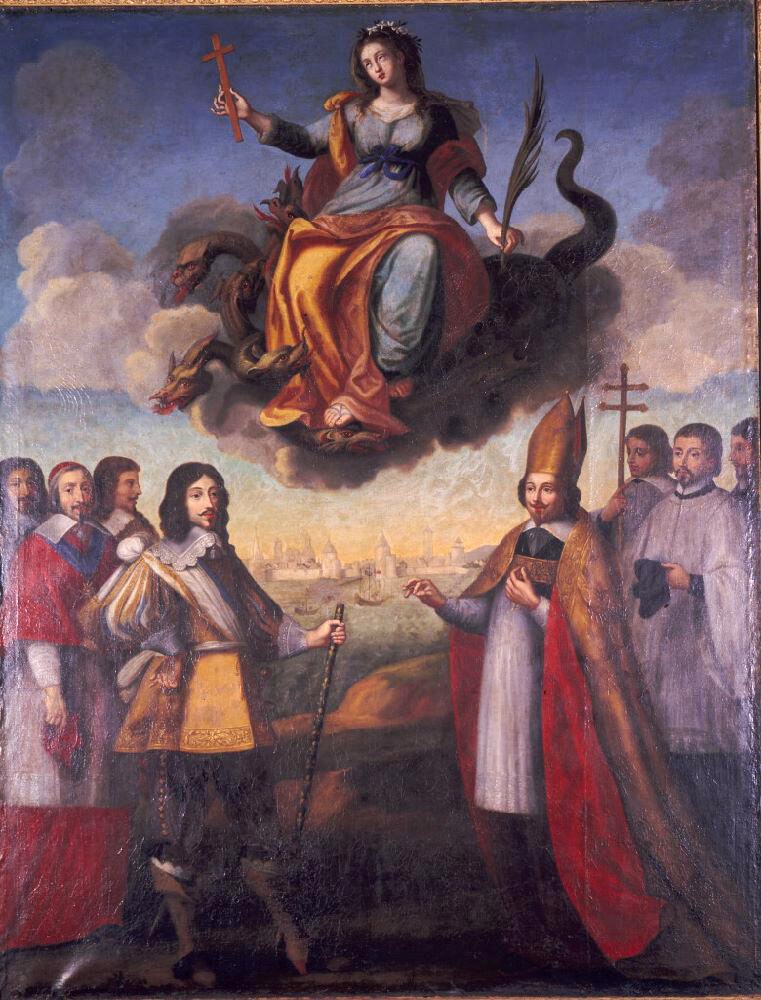
Entrée du roi Louis XIII à La Rochelle by Pierre Courtilleau

Available from Abebooks and Thriftbooks
Book Length: 622 pages
The reign of King Louis XIII and the activities of his close ally Cardinal Richelieu have been given more weight in literary narratives than histories—one has only to consider The Three Musketeers of Alexandre Dumas or Rostand’s play Cyrano de Bergerac. Consequently, the reality of the character and times of these two statesmen has been shrouded by literary myth, and myth that, at times, has marred their reputations; Tapié, however, has rendered us a marvelous service in dispelling the myth in favor of honest history.
While myth has portrayed Louis XIII as having been overshadowed by the supposedly Machiavellian Richelieu, Tapié corrects this record throughout the work by demonstrating how both men worked together for the betterment of France, and in a manner in which a Catholic reader may recognize as an evocative manifestation of the doctrine of the Two Swords. And he does not forget the humanity of his subjects, for the author has devoted considerable attention to the personalities of the king, the cardinal, and the traits which would influence their decisions in political life.
Louis XIII is revealed to us as a “complex and tortured personality” who “never knew what it was to be deeply loved” (92-93), yet a soul who turned to the Faith to help him bear his crosses:1
He was from his early days extremely devout, with a real love of God, the Virgin and the saints, and ready to resort to prayer, which gave him calm, consolation and strength. But his suspicious nature, as well as making him distrustful of others, also caused him to be overscrupulous.
(92)
This sobering piety of Louis XIII was, however, only one aspect of his personality, for complementing this was his martial spirit. Tapié describes him as:
…a king on horseback, a king who was used to commanding troops and ready to risk his own skin without hesitation, a king whose long rides across country brought him into direct contact with his realm.
(93)
Thus Louis XIII was a man of faith and action, not one content to languish in a palace or within the walls of his private chapel. In a manner entirely unlike that of our “elected” leaders—who in one sentence castigate us for our “carbon footprint” before taking a step to mount their private jets—here was a ruler who stepped into the life of his common subjects and the hardships of his soldiers not for a publicity stunt, but out of a king’s paternal love. Expanding on this characteristic humility, the author writes:
He might have become a sham king, a king who only appeared in religious ceremonies or among his courtiers. His contact with the broad mass of Frenchmen brought him close to his contemporaries; it was this, the most enduring feature of his complex and tortured personality, which more than anything else gave strength to his rule.
(Ibid)
As for Richelieu, Tapié highlights that he had “a high level of intelligence which undoubtedly set him apart from the majority of men”, and moreover “both a creative imagination which enabled him to plan major ventures, and a common sense which kept him clear of wild schemes” (136). To this combination of intelligence, imagination, and prudent judgment can be added his personal piety, a trait that this historian at certain times draws attention to. For instance, when closing his analysis of the cardinal’s personality, he remarks on how Richelieu’s vocation informed his self-effacing desire to serve his nation:
(Ibid)
Perhaps his lot as a priest best explains his rejection of the pleasures of private life in favour of his mission and the pursuit of his ideals. He had renounced the quest for happiness in this world. His will to participate in great deeds overrode everything.
Taken together, these strong personalities are, as can be surmised, the main characters of Tapié’s grand narrative. Yet, they are not the only personalities who appear within this text: for this historian also illustrates, though to a lesser extent, the personalities and roles of the prominent figures of contemporary French society. In doing so, he masterfully captures a truly diverse range of characters, from the arrogant Marie de Medici to the humble St. Vincent de Paul. Not only this, as he—much like Louis XIII—never loses sight of the significance of the common people in the events he is recounting.
It is not merely the events of Louis XIII’s reign that Tapié has neatly researched and recorded for us in this volume; it is also the dynamic shift of the French state and society from feudalism to absolutism. Owing in large part to a romanticization of feudalism and a denigration of absolutism within some Catholic circles, this historian’s assertion that this change was ultimately beneficial may come as a shock to such persons. Undoubtedly, absolutism presented challenges for the Church—but so did feudalism.
The faults of feudalism—such as its tendency towards particularism—were only exacerbated in nations that, as a result of the Protestant Revolution, lost numerous powerful families and a considerable number of their common people to the new creeds. France was one of these nations. As a result, the Huguenots in particular had unavoidable secessionist leanings, and given that a consequential sector of the nobility were among their ranks, the decentralized nature of the feudal society was bound to be exploited by them to create a state within a state. These leanings turned into violent conflicts whenever the throne was ascertained to be weak enough, and so the Wars of Religion that had been ended by Henry IV saw reignition under his son. La Rochelle was the major flashpoint of these new conflicts; La Rochelle, which called upon England to deliver them from their rightful monarch! Such secessionist attitudes needed to be crushed in order to save France from becoming a divided patchwork in creed and sovereignty—and this is what Louis XIII and Richelieu did by centralizing the state.
Another point on which this work sheds much light is the relationship between Richelieu and the Church, as the truth in this regard has been often overshadowed by falsehoods which attempt to show the cardinal as an internal enemy of the Church, a partisan to the Gallicans. In his examination of Richelieu’s character, Tapié establishes that:
(Ibid)
As was his duty as a statesman, Richelieu the king’s minister subordinated everything to ‘the conservation of the Crown’; but he never sacrificed Catholic doctrine or the Catholic faith.
More specifically than this, he elaborates in a later part of this work that Richelieu:
…had no intention of resorting to alliances with Protestant powers without anything to counterbalance them. This is proved by his conduct with regard to Bavaria. Many historians have mistakenly believed that his aim was purely and simply to bring about the revival of the Protestant party in Germany; and some of them have praised his tolerance or indifference in matters of religion, while others have blamed him for sacrificing the interests of the Church. This is a serious error. Richelieu’s aim was to raise up enemies against the emperor, and he accepted them as and where occasion offered.
(242)
Thus his alliances with Protestants were purely strategic in nature; those who accuse Richelieu of practicing realpolitik and being an uncritical friend of the Protestants omit the alliances he did forge with Catholic powers. These nations included Bavaria, Savoy, Mantua, and Parma, and also Portugal and Catalonia (both of whom France aided in wars of independence against Spain). Despite these facts, Richelieu’s foreign policy is bound to have its stern critics. As with the dévot faction of his time, there are those today who wish that France and Spain could have simply set aside their differences to join forces against the Protestants and the Mohammedans. Undoubtedly this would have been the ideal. However, these conditions were rendered impossible by the reality that great power politics had set the two nations against one another.
By means of her alliance with Austria and their vast holdings in Italy, Spain had effectively encircled France. Peace had been tried: royal marriages had been arranged between the French Bourbons and the Spanish Habsburgs in the 1610s, but even this had sadly failed to bring about an end to the rivalry. Consequently, another course had to be taken in order to preserve the French state. As in private life, one cannot force a determined enemy into a friend; one must therefore drop the unrequited yearning for good relations and recognize the determined enemy as an enemy. Richelieu had to take this course, and it meant having to accept allies against the Spanish-Austrian bloc “as and when the occasion offered.”
The war with Spain, then, was a matter dictated by the mutually opposing foreign policies between her and France. It was neither religious nor ideological, for Catholicism was the religion of the state in both nations, and these powers simultaneously moved in the direction of absolute monarchy. Moreover, it cannot be said that the Spanish state was acting “more Catholic” than France in her ambitions to forge a new continental hegemony on her terms: of Pope Urban VIII, the author writes that “he could hardly desire [Europe’s] submission to a single master, for this would have reduced his own position to that of an imperial chaplain” (102). This threat was no exaggeration—a Habsburg universal empire might have, in time, challenged the Pope’s spiritual primacy and independence in a similar manner to the Guelph-Ghibelline conflicts of the Middle Ages, in which the Empire sought to subordinate the spiritual sword to the temporal. Quite unlike modern wars, evidently this war was, as Tapié asserts, “not a war between two ideologies but between two policies pursued by peoples who both accepted the same ideology” (350).
Richelieu’s foreign policy won the war for France in the end. It did not bring about the best of all possible worlds; but by preserving a balance of power, it likely prevented a worse one from arising. It also restored France’s reputation as a great power and was complemented by the resurrection of her navy, a project spearheaded by the cardinal. Admittedly, the war efforts involved much sacrifice and trouble in the domestic sphere—but these two statesmen wisely concerned themselves with the future in attending to them, though it was a future that they did not live to witness. Had they not taken this course, as the author argues, France would have become the sick man of seventeenth century Europe:
(429-430)
Without committing ourselves to arguments based on assumptions and events which did not take place, we cannot overlook the fact that there was no longer a French navy in 1610. France was economically dependent on Dutch, Spanish and English merchant ships and thus in a sense a blockaded country. One cannot but realise that, if she had been left to her own devices and her population had been allowed to drift along in a way of life which at the best of times hardly bore witness to a general state of peace and well being, her position would have degenerated into a vassal state whose subjects worked for the benefit of foreigners…Disintegration or survival: these were the alternatives with which France was confronted. Louis XIII and Richelieu chose survival.
When one understands the struggle that was overcome, this survival becomes all the more marvelous. It may be stated that the low time preference nature of monarchy produces leaders who willingly make short-term sacrifices for the benefit of the future, and there is indeed much truth to this. But we must also credit the individual virtue and talent of Louis XIII and Richelieu, for it was these men who charted this difficult course to create a better future for their nation. And what a great future awaited France! She was to become the foremost cultural and geopolitical power in the continent under Louis XIV, and the mere outlines of her empire were to become immense domains that evangelized and civilized millions.
A perennial lesson lies in this: to revive a great nation, one needs virtuous leaders who chose survival over disintegration, though this may entail means that may temporarily discomfort the populace. Louis XIII and Richelieu chose survival for France; we must find leaders who will choose survival for the West. Sooner will a camel pass through the eye of a needle before men of that sort win elections in our liberal democracies.
This study is then a magnificent history of these two great statesmen, but also of their times. Where other historians veer into anachronisms, Tapié soundly avoids them. His treatment of the Church is fair and cordial, but it must be admitted that he does not take an openly Catholic assessment of the events and times. For while Tapié attempts to stay neutral, a Catholic understanding reveals the king and cardinal not only as French national heroes, but also defenders of Christendom. Despite these minor qualms, this text is recommended to the sincere student of history, especially those seeking to understand Catholic statecraft in an age of crisis.